Because children who can say what they mean are children who rarely need to scream it.
kiransaifmontessori.com
Last week, a parent told me something that has stayed with me. Her four-year-old had a meltdown at the supermarket — not the usual tired-and-hungry kind, but a full twenty-minute storm that left them both on the floor of the cereal aisle, equally exhausted. Later, at home, when things were calmer, she asked what had happened.
Her daughter looked up and said: ‘I was trying to tell you something and you weren’t listening and then the words got stuck and my body just did it instead.’
The words got stuck. And the body did it instead.
That is the clearest description of what happens when a child cannot yet express themselves that I have ever heard from a child. And it is also, when you think about it, a description of what happens to all of us — at any age — when we cannot find the words for what we are feeling or needing. The body steps in. The tantrum, the withdrawal, the silence, the aggression — these are not behaviour problems. They are communication problems. The words got stuck.
This guide is about unsticking the words. About building the skills, the vocabulary, the confidence, and the environment that helps children say what they mean — clearly, calmly, and in ways that people around them can actually hear.
Why Some Children Struggle to Express Themselves
Before we talk about solutions, it is worth understanding why some children find self-expression genuinely difficult. Because it is not usually about intelligence or personality. It is almost always about one or more of these things:
Their emotional vocabulary is limited
You cannot name what you do not have a word for. A child who only knows happy, sad, and angry has a very small emotional toolkit to work with. When something more nuanced happens — when they feel embarrassed, or overlooked, or overwhelmed, or jealous — they have no word for it, so they cannot say it. The feeling finds another way out.
This is why emotional vocabulary work is not optional. It is the foundation of everything else.
They have not been given enough space to practice
Children learn to express themselves by expressing themselves — by talking, being listened to, making mistakes, trying again, and gradually getting better at it. In busy households, in classrooms with thirty children, in cultures where children are expected to be seen but not heard, that practice space is often simply not available. The skill does not develop because the opportunity to practise it does not arise.
Adults have not modelled it clearly enough
Children learn language, including the language of feelings and needs, by absorbing what they hear around them. Parents who say ‘I’m fine’ when they clearly are not, who never articulate their own frustration or sadness or tiredness, who change the subject when emotions come up — they are modelling emotional inarticulacy. Not on purpose. But modelling it nonetheless.
They are afraid of the response
This one is harder to admit. Some children do not express themselves because the last time they did, the response was dismissive, or frightening, or made things worse. A child who said ‘I don’t want to’ and was punished for it. A child who cried and was told to stop. A child who tried to explain and was talked over. These children learn quickly that expressing themselves is not safe, and they stop trying.
None of these are reasons to feel guilty. They are reasons to understand. And once you understand them, you can do something about them.
The Environment Comes First
Before we talk about what to teach, we need to talk about where the teaching happens. Because a child who does not feel safe will not express themselves clearly, no matter how many techniques you use. The environment — emotional and physical — has to be right first.
Make it safe to say things
This sounds obvious. It is harder than it sounds. A child needs to know, through consistent experience, that saying what they feel will not result in punishment, ridicule, or dismissal. That saying ‘I don’t like that’ will not be met with ‘you are being ridiculous.’ That saying ‘I am scared’ will not be met with ‘there is nothing to be scared of.’
Emotional safety is built slowly, through a thousand small interactions where you receive what your child says without immediately trying to fix, dismiss, or correct it. It is the most important work you will ever do as a parent, and it has nothing to do with any technique or material.
Slow down
Most modern households move at a pace that is genuinely hostile to expression. There is no time between activities, no space between sentences, no pause in which a child can gather themselves and say what they need to say. Self-expression requires time. It requires the adult to stop, turn toward the child, and wait. Not while scrolling. Not while cooking. Actually wait.
Twenty seconds of genuine attention communicates more safety than twenty minutes of half-present listening.
Lower your own volume
Children who live in loud households often become either very loud themselves — trying to be heard above the noise — or very quiet, having given up on being heard at all. Neither is healthy self-expression. When the baseline noise level is lower, there is room for quieter, more nuanced communication. You do not have to run a silent household. But you can notice when you are too loud for your child to feel heard.
A question worth sitting with: When my child tries to tell me something, do I usually stop what I am doing? Or do I listen while also doing something else?

Building Emotional Vocabulary — The Bedrock Skill
The single most important thing you can do to help your child express themselves more clearly is to give them more words for what they feel. Not just happy, sad, and angry — but the whole rich, specific, human vocabulary of emotion.
Start with the obvious ones, then go deeper
Happy, sad, angry, scared — these are the starting point. But the more specific vocabulary becomes, the more useful it is. Frustrated is different from angry. Embarrassed is different from sad. Overwhelmed is different from scared. Jealous is different from upset. Lonely is different from bored.
These distinctions matter enormously. A child who can say ‘I feel overwhelmed’ rather than just ‘I feel bad’ has given both themselves and the adults around them something to work with.
Name feelings in real time — yours and theirs
The most natural way to teach emotional vocabulary is to use it constantly in context. When something happens that carries a feeling with it, name the feeling: ‘That was really disappointing. We were both looking forward to that.’ Or: ‘I can see that felt unfair. Is that what happened?’
And crucially — name your own feelings out loud. Not dramatically, not as a performance, but matter-of-factly. ‘I am feeling a bit tired and that made me short with you just now. I am sorry.’ ‘I am really excited about this trip. I have been looking forward to it all week.’ This is not weakness. This is modelling.
Use books and stories as a vocabulary laboratory
Every story is full of emotional moments that can be named and discussed without any pressure. A character who is let down by a friend, who has to do something frightening, who feels left out — these are safer to talk about than the child’s own raw experiences. ‘How do you think she felt when that happened?’ gives a child practice at naming feelings in a low-stakes context that makes naming their own feelings easier later.
The emotion wheel
Emotion wheels — visual diagrams that show the spectrum of human feelings in all their variety and gradation — are a genuinely useful tool for both children and adults. Having one on the wall, looking at it together, pointing to how you feel rather than having to find the word from nothing — these are small but real scaffolds for emotional expression. They work especially well for children who are visual learners or who find words hard to access in emotionally heightened moments.
An emotion wheel is not a replacement for conversation. It is a bridge to it. A child who can point to a feeling is a child who is already beginning to communicate
Teaching Children to Name Their Needs — Not Just Their Feelings
Emotional vocabulary is the foundation. But the next layer is equally important: helping children move from naming what they feel to naming what they need. Because most difficult behavior is not primarily about emotion — it is about an unmet need that the emotion is signaling.
The difference between feelings and needs
A child who says ‘I feel angry’ has told you something. A child who says ‘I feel angry because I need more time before we leave and I did not get it’ has given you something you can actually work with. Teaching children to connect feelings to needs — ‘I feel this because I need that’ — is one of the most powerful communication skills there is, and it is one that most adults have never been explicitly taught either.
Model needs-based language yourself
‘I am feeling overwhelmed because I need a few minutes of quiet before dinner.’ ‘I am feeling frustrated because I need us to be ready to leave by three and we are running late.’ When children hear adults connecting their feelings to their needs in specific, non-blaming language, they absorb that pattern and begin to use it themselves.
Ask the right questions
When your child is upset, instead of ‘what is wrong?’ try ‘what do you need right now?’ The first question asks them to diagnose and explain their emotional state, which is hard when you are in it. The second question redirects toward something actionable and forward-looking. Even if they cannot answer it immediately, it plants the right frame.
Worth trying today: When your child is struggling, ask: ‘What would help right now?’ and wait — even if the silence is uncomfortable. Let them think. You might be surprised by what they say.

Practical Skills — How to Actually Say It
Once a child has the emotional vocabulary and the safety to use it, the next step is giving them the practical communication skills to say things clearly. These are skills that can be explicitly taught, practiced, and improved with time.
The full sentence habit
Many young children communicate in fragments — ‘want’, ‘hungry’, ‘no’, ‘there.’ This is developmentally appropriate at two, but by three and four, children can be gently encouraged toward full sentences. Not corrected harshly, not drilled, but invited: ‘Can you tell me that in a whole sentence? Something like: I want some water because I am thirsty.’ The model does more work than the correction.
Slowing down the voice
Children who are anxious or excited often speak too fast to be understood. This is not a speech problem — it is a regulation problem. When a child’s speech is too fast and too muddled to understand, the most useful response is not ‘slow down’ — it is to model slow speech yourself. ‘I heard you starting to tell me something. Take a breath. Tell me again slowly. I am listening.’ Your pace sets their pace.
Eye contact — but not forced
‘Look at me when you talk to me’ is one of those instructions that feels like it should produce better communication and actually often produces worse communication, because it adds pressure to an already difficult moment. Natural eye contact comes when a child feels safe and heard — not when it is demanded. What you can do is make eye contact yourself: get down to their level, turn toward them, and look at them with the kind of attention that tells them: I am here and what you are saying matters.
The four-part message
For older children (five and above), teaching the structure of a clear message is genuinely useful. The structure is simple: what happened, how I felt about it, what I needed, and what I would like to be different. ‘When you took my crayon without asking, I felt angry because I was using it. I would like you to ask me first next time.’ This is not natural speech — it is scaffolded speech that gradually becomes natural with practice.
Do not expect this to come out perfectly in the heat of conflict. Practice it in calm moments, in role play, in conversations about characters in books. It becomes available in real moments over time.
Assertiveness without aggression
There is a crucial distinction between saying what you need clearly and saying it in a way that attacks or blames. Children need to learn — again, through modelling more than instruction — that they can say ‘I do not want to do that’ without saying ‘I hate you for asking.’ That they can say ‘that hurt my feelings’ without saying ‘you are mean.’ The content of the message and the delivery of the message are separate skills, and both need to be developed.
The Role of Play in Building Self-Expression
Children process and practice the things that matter to them through play. The child who plays out a scary scenario with toy figures is rehearsing emotional and narrative expression. The child doing puppet shows is practicing voice, perspective, and story. The child doing pretend play of any kind is building the language of feelings, relationships, and human complexity.
This is not incidental to the work of teaching self-expression. It is the work. Play is where children find and test the words they will later use in real moments.
Dramatic play and role play
Setting up scenarios for role play —
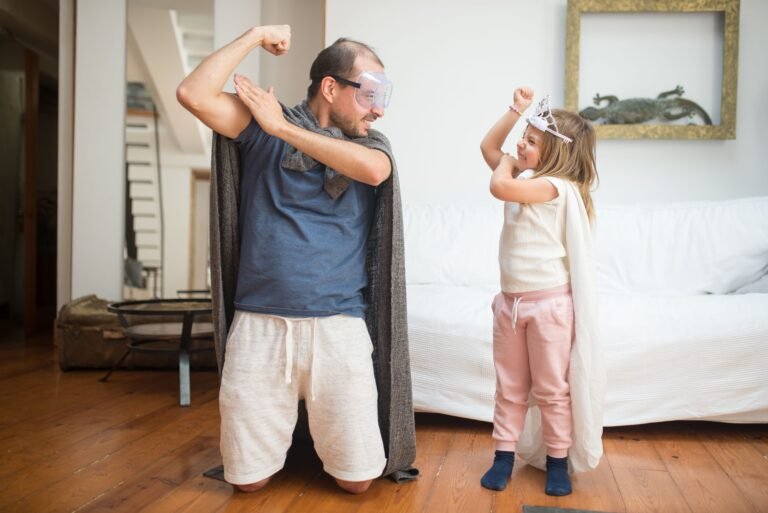
Setting up scenarios for role play — ‘let’s play that you are the doctor and I am the patient’ or ‘you be the teacher and I will be in your class’s — gives children a rehearsal space for social communication that is safe because it is fictional. They can try out assertiveness, empathy, negotiation, and conflict resolution in the play before they need them in real life. This is invaluable.
Puppet play
Puppets offer a particular kind of freedom — the freedom to say things behind a mask. Children who are shy or who find direct expression difficult will often speak through a puppet with remarkable openness and articulation. They will say things the puppet knows that they themselves cannot yet say directly. This is not avoidance. It is a bridge.
Storytelling and narrative
Children who are given regular opportunities to tell stories — real or invented — develop a fluency with language and narrative that carries directly into all forms of self-expression. Tell me about your day is a story. Tell me what happened on the playground is a story. Tell me what we should do this weekend is a story. The more practice a child has at telling stories, the more capable they become at the specific story they most need to tell: the one about what they are feeling and why.
How Montessori Builds Self-Expression From the Ground Up
In the Montessori environment, self-expression is not taught as a separate skill. It is built into the entire structure of the day.
Children in a Montessori classroom choose their own work. They negotiate with their peers for materials. They resolve conflicts without automatically running to an adult. They present their work to others. They participate in group discussion called the circle time or morning meeting, where everyone has a voice and everyone listens.
The result, over three years in a Montessori 3-6 environment, is remarkable. Children who have had to say what they want, negotiate for it, express disagreement, ask for help, and describe their thinking to others daily — these children arrive at primary school with a self-expression capability that their peers are often still developing years later.
Here is what specifically builds it:
Freedom of choice builds the language of preference
A child who chooses their own work every day of their life develops the language of preference naturally: I want, I prefer, I am interested in, I find this difficult, I would like to try. This vocabulary of personal desire and agency is the foundation of self-expression.
The three-period lesson builds precise vocabulary
Every Montessori material is introduced with precise language — not ‘the big one and the small one’ but ‘the longest rod and the shortest rod.’ Not ‘the bumpy one’ but ‘the rough surface.’ This precision of language, modelled consistently by teachers and absorbed by children through hundreds of three-period lessons, builds a precision of expression that goes far beyond Montessori materials.
Conflict resolution is explicitly taught and practised
In a Montessori classroom, when two children have a conflict, they are not immediately separated and corrected. They are brought together and helped to say what happened, how they felt about it, and what they need. This is conflict resolution but it is also communication practice. Every conflict is an opportunity to teach the language of clear, calm self-expression — and there are many conflicts in a room full of three- to six-year-olds.
Books, Tools and Materials That Help Children Find Their Voice
A few carefully chosen resources can do a great deal of quiet work alongside everything else. Here are some that genuinely support children’s self-expression development — from our own shop and from Amazon:
From KS Montessori
- Sandpaper Letters — Rich, precise phonetic language from the earliest years. Children who can name letter sounds with confidence are children who are building the raw material of verbal expression — one sound, one word, one sentence at a time.
- Montessori Wooden Movable Alphabet with Box — Word building with the Movable Alphabet gives children a way to express their thoughts in written form before they can write — building the connection between what is thought and what is communicated.
Montessori Preschool Workbook: 200+ Educational Activities — Language activities embedded in engaging, varied exercises — vocabulary building.
Feelings Flashcards for Children — Emotions Learning Cards — A simple, visual tool that gives children a concrete way to identify and name their feelings. Particularly useful for children who are visual learners or who struggle to access words during emotionally heightened moments. Place them where your child can reach them independently.
The Zones of Regulation — A Curriculum Designed to Foster Self-Regulation — Widely used by occupational therapists and school counsellors, this framework helps children identify how regulated or dysregulated they are and develop strategies for self-expression and self-management. Available as a workbook for home use.
Puppets for Children — Hand Puppet Set for Storytelling — A set of well-made hand puppets that opens up dramatic play, storytelling, and the kind of behind-the sequencing, storytelling prompts — all supporting the language development that underpins clear expression
The Whole-Brain Child — Daniel J. Siegel and Tina Payne Bryson — One of the most practical and science-grounded parenting books available on helping children integrate emotional and rational brain function. The chapter on naming feelings to tame them is worth the entire book. Every parent working on self-expression with their child should read this.
expression that many children find genuinely liberating. Particularly valuable for shy children and children who find direct expression difficult.
My Feelings Journal — Emotions Diary for Kids — A structured but open-ended journal that guides children through identifying, naming, and reflecting on their feelings. Ideal for children aged five and above who can write or draw. The act of putting feelings into words on paper is itself a powerful self-expression practice.
Eeboo Feelings and Emotions Card Game for Kids — A beautifully illustrated card game that makes talking about feelings genuinely enjoyable. Children take turns drawing cards and sharing — building emotional vocabulary, perspective-taking, and comfortable conversation about inner experiences in a low-pressure, playful format.
What Gets in the Way — And What to Do About It
Even with the best intentions and the best environment, some situations make clear self-expression particularly hard for children. Here are the most common ones and what actually helps:
When emotions are too big for words
There are times when a child’s feelings are simply too large, too fast, or too overwhelming for words to arrive. In these moments, the worst thing you can do is ask them to use their words. The best thing you can do is be physically present — get down to their level, stay calm, say something brief and warm like ‘I am here’ — and wait. When the emotional storm passes, the words come back. Not before.
When they use whining instead of words
Whining is not laziness. It is usually communication without the confidence that direct communication will work. A child who whines has learned, through experience, that a more direct request either gets ignored or gets a no — and whining is the workaround. The solution is to respond warmly to direct requests, every time, even when the answer is still no. ‘I love that you asked me clearly. The answer is no for now, but thank you for telling me.’ This teaches the child that direct expression works, even when the outcome is not what they hoped.
When they say nothing at all
Some children go silent when asked about their feelings. They shrug. They say they don’t know. They look at the floor. This is often not avoidance — it is genuine difficulty accessing and articulating inner experience. For these children, indirect routes work better than direct questions. ‘I wonder if you might be feeling a bit of this’ while pointing to an emotion chart. Or ‘if your feeling were a color right now, what color would it be?’ These sideways approaches lower the pressure enough to let something in.
When they express themselves clearly but aggressively
A child who says ‘I HATE you and I NEVER want to see you again’ is expressing themselves. Clearly. With feeling. The content is real even if the delivery is not yet skillful. The response is to receive the feeling without endorsing the attack: ‘You are really, really angry with me right now. I heard that. When we are both calmer, I want to understand what happened.’ This separates the emotion (valid) from the expression (needing work) in a way the child can eventually learn from.
A Note on Quiet Children
Not every child who does not express themselves loudly or frequently is struggling. Some children are naturally quiet, thoughtful, and inward-processing. They think before they speak. They observe before they engage. They feel deeply without necessarily needing to announce it.
These children are not broken. They are not behind. They are not failing at self-expression. They are doing it in their own register, at their own pace.
The question is not ‘how do I get my quiet child to talk more?’ The question is ‘does my quiet child feel that if they wanted to express something, they could? And that it would be received?’
If the answer to that second question is yes, you have done your job. The rest is temperament, and temperament is not a problem to be solved.
The goal is never volume. The goal is safety. A child who says little but says it clearly and confidently is a child who has found their voice. That is enough.

Starting Today — Three Small Things
If you have read this far and you are wondering where to begin, here are three things you can do today that cost nothing and take very little time:
One: name one of your own feelings out loud
Not a performance of it. Just a quiet, factual mention: ‘I am feeling a bit tired today’ or ‘I really loved that — it made me happy.’ Let your child hear you do it. That is it. That is the whole thing.
Two: when your child tries to tell you something, stop completely
Put down what you are holding. Turn toward them. Look at them. Listen all the way to the end. Do not start answering until they are finished. Then, before you say anything else, reflect back: ‘So what happened was…’ or ‘It sounds like you felt…’ Give them the experience of being fully received. Most children do not get this often enough.
Three: ask a different question at bedtime
Instead of ‘how was your day?’ — try one of these: ‘What was the best moment today?’ or ‘Was there anything that felt hard?’ or ‘Did anything surprise you?’ These questions invite specific, feeling-based responses. Over time, the bedtime conversation becomes one of the richest self-expression practices in a child’s day.
These three things, done consistently, will change more than any technique or material. They will change the relationship. And the relationship is where self-expression lives.
The Long View
A child who can express themselves clearly is not just better at communicating in the immediate moment. They are better at managing their own emotions, because naming a feeling is the first step toward regulating it. They are better at resolving conflicts, because they can say what they need instead of acting it out. They are better at asking for help, which means they are less likely to struggle alone with things they could be supported through. They are better at forming and sustaining relationships, because people feel heard around them.
These are not small things. These are the things that determine the quality of a life.
And they begin here, now, in the ordinary moments of an ordinary day — when you stop, turn toward your child, and let them know: I am listening. What you have to say matters. Take all the time you need.
That is the whole lesson. Everything else is detail.