Top 10 Amazon Montessori Materials for Toddlers
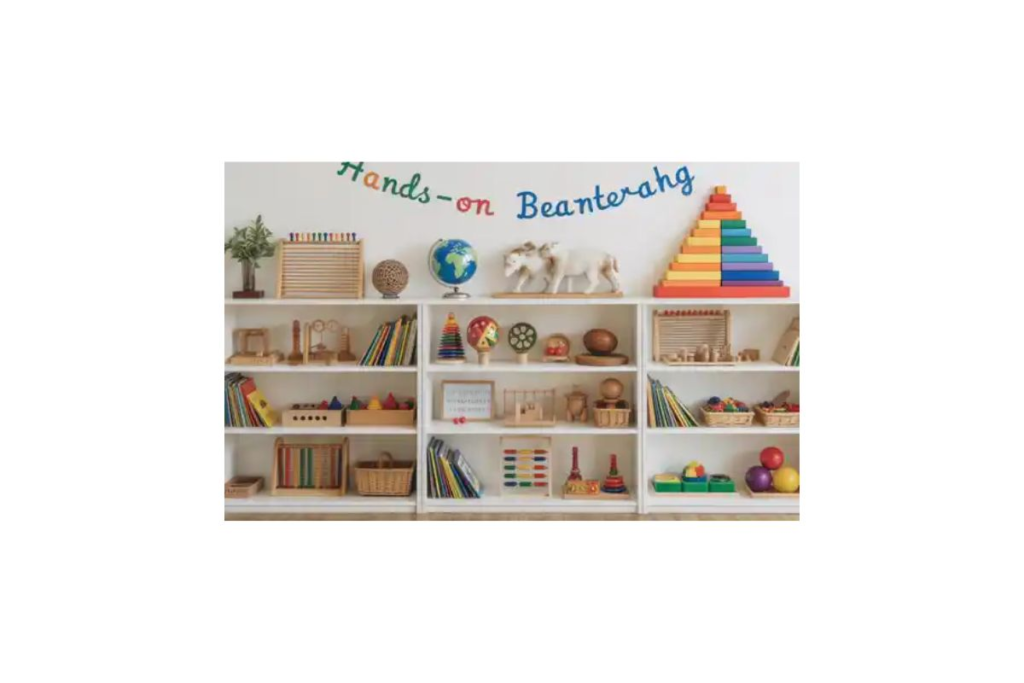
A Guide for Parents & Educators Published by KS Montessori | Your Child’s Learning Journey Starts Here Walk into any authentic Montessori classroom and you’ll notice something immediately different: the shelves are lined not with flashcard drills or battery-powered toys, but with beautiful, purposeful, hands-on materials. Every wooden block, every sandpaper letter, every spindle — has a reason for being there. Montessori materials are not just “learning toys.” They are scientifically designed tools rooted in over a century of child development research by Dr. Maria Montessori. When used consistently — at home or in the classroom — they support a child’s natural development across cognitive, motor, language, and mathematical domains in ways that passive instruction simply cannot replicate. In this guide, we’ll walk you through the core categories of Montessori materials, explain why each one matters, and point you to trusted, high-quality options you can bring into your home or classroom today. The Montessori Philosophy: Why Materials Are Central Dr. Montessori believed that children learn best through direct, multi-sensory interaction with their environment — not through rote memorization or passive listening. She observed that children have what she called “sensitive periods”: windows of time during which they are especially receptive to absorbing specific skills or knowledge. Montessori materials are designed to meet children precisely during these sensitive periods. They are: Self-correcting — the child can identify and fix mistakes without adult intervention, fostering independence and critical thinking. Hands-on — physical manipulation of materials builds neural pathways that abstract instruction cannot. Sequentially ordered — each material builds on the last, creating a scaffold toward mastery. Beautiful and inviting — aesthetics matter; children are drawn to work that looks purposeful and well-crafted. Together, these qualities turn learning into a joyful, intrinsically motivated activity — which is the cornerstone of the Montessori approach. Sensorial Materials: Training the Senses, Building the Mind Before a child can understand abstract concepts like “big” or “small,” “rough” or “smooth,” they need concrete, physical experiences that give those words meaning. Sensorial materials are designed to isolate and refine each of the senses — visual, tactile, auditory, and more. The Pink Tower Few Montessori materials are as iconic as the Pink Tower — ten solid wooden cubes that differ in three dimensions, from 1 cm³ to 10 cm³. This single material packs an enormous developmental punch: Develops visual discrimination and fine motor control as children carefully stack the cubes from largest to smallest. Introduces foundational mathematical concepts — dimension, order, and graduated series. It is self-correcting: if a cube is misplaced, the tower won’t look right — and the child learns to self-regulate. Recommended: Adena Montessori Pink Tower — expertly crafted for durability and dimensional accuracy. Geometry & Shape Recognition Geometric materials help children understand shape, symmetry, and spatial reasoning long before formal geometry is introduced in school. Research shows that early spatial reasoning is one of the strongest predictors of mathematical ability later in life. Recommended: Gudong Montessori Geometrical Materials — professional-quality shapes designed for early childhood exploration. Cylinder Blocks Mini cylinder blocks develop the three-finger pincer grip — the same grip used to hold a pencil — while simultaneously training the eye to discriminate size. These deceptively simple materials are doing double duty: preparing children for writing while sharpening visual perception. Recommended: Adena Montessori Mini Cylinder Blocks — a beautifully made set that engages children for years. Language Materials: From Letters to Literacy The Montessori approach to literacy is multi-sensory and deeply respectful of how children actually learn to read. Rather than drilling phonics charts, children feel, trace, and internalize letter sounds before they ever pick up a pencil. The result? Children who don’t just decode words — they understand language. Sandpaper Letters Sandpaper Letters are one of the most powerful pre-reading tools ever developed. Each letter is cut from sandpaper and mounted on a wooden board. Children trace the letter with their fingers while saying the phonetic sound — engaging sight, touch, movement, and hearing simultaneously. This multi-sensory approach is backed by neuroscience: encoding information through multiple senses creates stronger, longer-lasting memory traces. Children who learn letters through Sandpaper Letters often move to writing before they move to reading — they have physically internalized the letter forms. Helps children with dyslexia or reading difficulties by providing tactile reinforcement of letter shapes. Teaches correct letter formation before bad habits form. Lower and uppercase versions ensure full literacy preparation. Recommended: Lower & Capital Case Sandpaper Letters Set — a complete set covering both cases for comprehensive literacy readiness. Mathematics Materials: Concrete to Abstract One of the most transformative aspects of Montessori education is how it approaches mathematics. Rather than introducing numbers as abstract symbols, Montessori begins with concrete, tangible materials that give quantity a physical reality. Children who learn math this way don’t just memorize — they understand. Spindle Box The Spindle Box introduces children to the concept of zero and quantity in a concrete, hands-on way. Children count out spindles and place them in compartments numbered 0–9, physically experiencing what “none” (zero) looks and feels like — a concept that trips up many children when presented abstractly. Recommended: Spindle Box with 45 Spindles — a beautifully crafted traditional Montessori staple. Montessori Mathematics Materials Set For parents and educators looking to provide a complete foundation, a comprehensive mathematics materials set offers children progression from basic counting all the way through early operations. These materials span years of learning and grow with the child. Number rods build the concept of quantity as continuous, graded amounts. Bead materials make place value (tens, hundreds, thousands) physically tangible. Counters and cards connect numeral symbols to physical quantities. Recommended: Montessori Mathematics Materials Preschool Education Set — a comprehensive set supporting the full mathematical sequence. Practical Life & Sensory Materials: The Foundation of Everything In Montessori, practical life