Process Art vs Product Art:Which One Actually Helps Your Child?
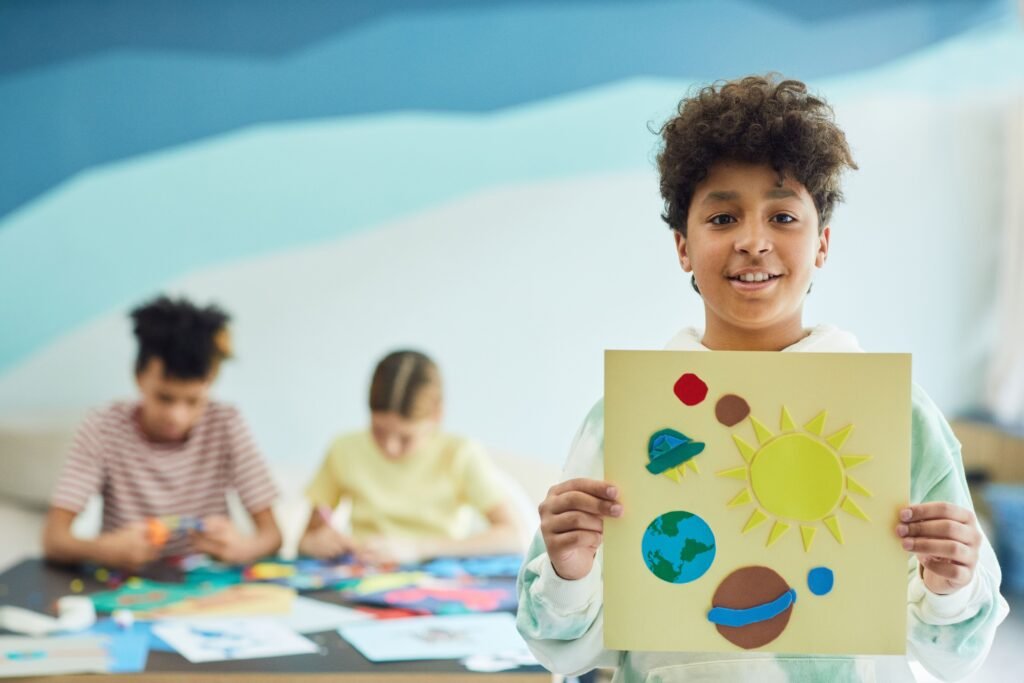
“A Montessori perspective on creative development — and why the mess matters more than the masterpiece“ Picture two scenes. In the first one, a four-year-old sits at a table covered in newspaper. In front of her are three pots of paint, a large sheet of white paper, and no instructions whatsoever. She starts by dipping her brush in the blue. Then she uses her finger and discovers that mixing blue and yellow makes something interesting happen. She spends twenty-five minutes doing this, completely absorbed, occasionally humming. The painting she produces looks, to an adult eye, like an energetic mess. To her, it is exactly what she wanted. In the second scene, a four-year-old sits at a table with a printed outline of a butterfly. He has been told which sections to colour in which colour. He works carefully within the lines. When he finishes, the butterfly looks like the example the teacher held up. His parent puts it on the fridge. Both children made art today. But only one of them actually did. That is the difference between process art and product art. And understanding it — really understanding it, not just as a theory but as a lived choice you make every time you sit your child down with a paintbrush — changes how you think about creativity, learning, and what art is actually for. So What Exactly Is the Difference? Process art Process art is child-led, open-ended creative experience where the activity itself is the point. There is no template to follow, no correct outcome, no example to replicate. The child decides what to make, how to make it, when it is finished, and what it means. An adult’s role is to provide materials, space, and enough trust to step back and let the exploration happen. It looks messy or may be often looks like nothing in particular. You cannot always tell what it is supposed to be — and that is completely fine, because it is not supposed to be anything. It is supposed to be whatever the child’s hands and mind made of the materials they were given. Product art Product art is adult-led, outcome-focused creative activity where the goal is a specific, predetermined result. The child follows a template, copies a model, colours within provided lines, or assembles pre-cut pieces. An adult has decided in advance what the finished piece should look like and child’s job is to execute the plan. It often looks impressive. Parents can immediately tell what it is. It photographs well and fills the fridge for a few weeks. And it teaches the child almost nothing about creativity, expression, or their own capacity for original thought. A child who has only ever done product art learns that art is something other people design and they execute. A child who has done process art learns that art is something they invent. These are not the same lesson. Why Process Art Matters — What It Actually Builds This is not just a philosophical preference. Process art builds specific, measurable capacities in young children that product art simply does not — and some that product art actively undermines. Here is what the research and the developmental science say: Creative thinking and problem-solving When a child has no template to follow, they have to make decisions. What colour? How much? What next? If I mix these what will happen? These micro-decisions, made hundreds of times across a creative session, are exactly the cognitive work of creative thinking. The child is generating options, evaluating them, choosing, executing, and adapting. This is problem-solving — the same cognitive process that will serve them in mathematics, science, writing, and every domain of human endeavour. Product art offers none of this. When the template has already decided what color the sky should be, the child’s creative brain is not needed. Intrinsic motivation and the love of making things Children who do process art regularly develop an intrinsic relationship with the act of making — they create because creating is satisfying, not because the result will earn praise. This is one of the most valuable things a child can develop: the ability to be motivated from within, to pursue something because it genuinely matters to them, regardless of how it looks to anyone else. Product art, by contrast, is almost entirely driven by external motivation — the approval of the finished result, look on the parent’s face, and the thing on the fridge. When that external validation is removed, the motivation evaporates. This is why children who have only done product art often say ‘I can’t draw’ and mean ‘I can’t draw in a way that looks right.’ The bar they are measuring themselves against is always someone else’s standard. Confidence and self-efficacy A child who decides what to make and then makes it has had an experience of being genuinely capable. They set the intention, executed the plan, and produced something that was entirely their own. This feeling — I made something that came from me — is one of the most powerful confidence-builders available to a young child. A child who colours inside someone else’s lines has had a different experience: they have done something correctly, which is not the same thing. Correctness is measured against an external standard. Capability is measured against their own intention. Concentration and sustained attention Children in genuine process art experiences concentrate for far longer than children doing product art. The reason is simple: they are genuinely engaged and are making real decisions, encountering real surprises, and doing real creative work. The attention is self-generated rather than externally maintained. This is the same principle behind the Montessori work cycle. Genuine engagement, freely chosen, generates the deepest and most sustained concentration available to a young child. Emotional expression and regulation Art is one of the oldest human tools for expressing what cannot be said in words. For young children who are still developing verbal communication, the ability to express emotion through colour, mark-making, and