“A Montessori perspective on creative development — and why the mess matters more than the masterpiece“
Picture two scenes.
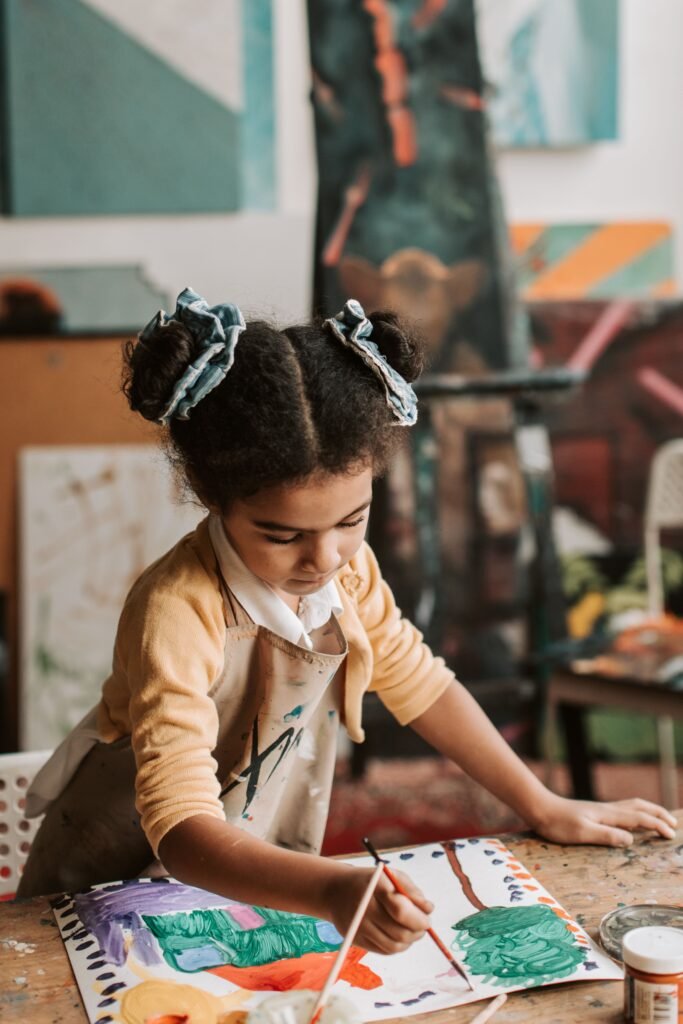
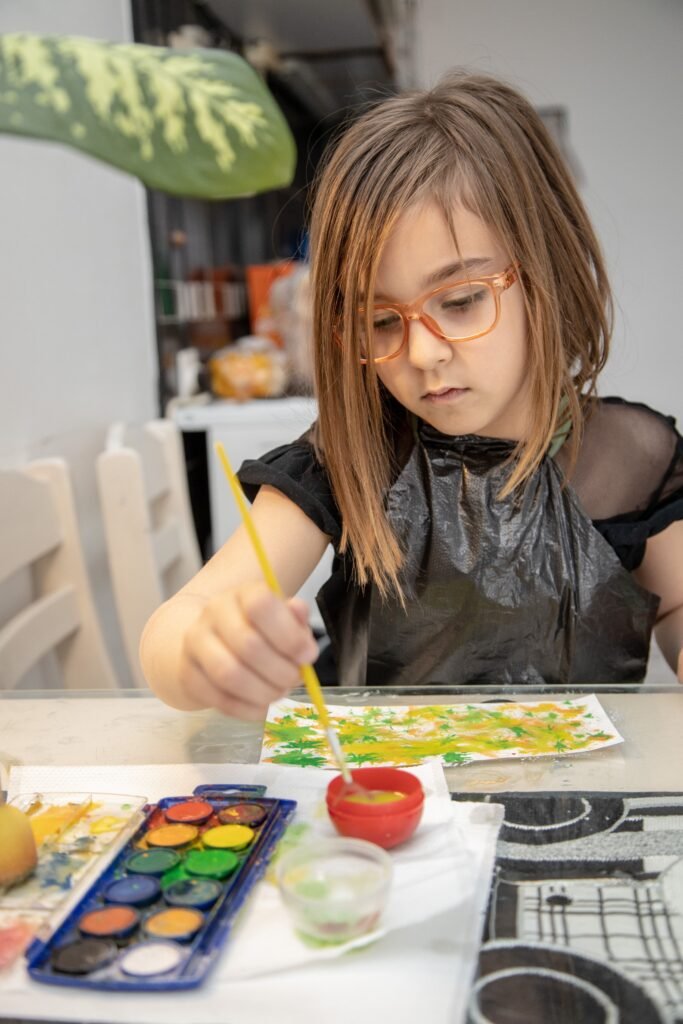
In the first one, a four-year-old sits at a table covered in newspaper. In front of her are three pots of paint, a large sheet of white paper, and no instructions whatsoever. She starts by dipping her brush in the blue. Then she uses her finger and discovers that mixing blue and yellow makes something interesting happen. She spends twenty-five minutes doing this, completely absorbed, occasionally humming. The painting she produces looks, to an adult eye, like an energetic mess. To her, it is exactly what she wanted.
In the second scene, a four-year-old sits at a table with a printed outline of a butterfly. He has been told which sections to colour in which colour. He works carefully within the lines. When he finishes, the butterfly looks like the example the teacher held up. His parent puts it on the fridge.
Both children made art today. But only one of them actually did.
That is the difference between process art and product art. And understanding it — really understanding it, not just as a theory but as a lived choice you make every time you sit your child down with a paintbrush — changes how you think about creativity, learning, and what art is actually for.
So What Exactly Is the Difference?
Process art
Process art is child-led, open-ended creative experience where the activity itself is the point. There is no template to follow, no correct outcome, no example to replicate. The child decides what to make, how to make it, when it is finished, and what it means. An adult’s role is to provide materials, space, and enough trust to step back and let the exploration happen.
It looks messy or may be often looks like nothing in particular. You cannot always tell what it is supposed to be — and that is completely fine, because it is not supposed to be anything. It is supposed to be whatever the child’s hands and mind made of the materials they were given.
Product art
Product art is adult-led, outcome-focused creative activity where the goal is a specific, predetermined result. The child follows a template, copies a model, colours within provided lines, or assembles pre-cut pieces. An adult has decided in advance what the finished piece should look like and child’s job is to execute the plan.
It often looks impressive. Parents can immediately tell what it is. It photographs well and fills the fridge for a few weeks. And it teaches the child almost nothing about creativity, expression, or their own capacity for original thought.
A child who has only ever done product art learns that art is something other people design and they execute. A child who has done process art learns that art is something they invent. These are not the same lesson.
Why Process Art Matters — What It Actually Builds
This is not just a philosophical preference. Process art builds specific, measurable capacities in young children that product art simply does not — and some that product art actively undermines. Here is what the research and the developmental science say:
Creative thinking and problem-solving
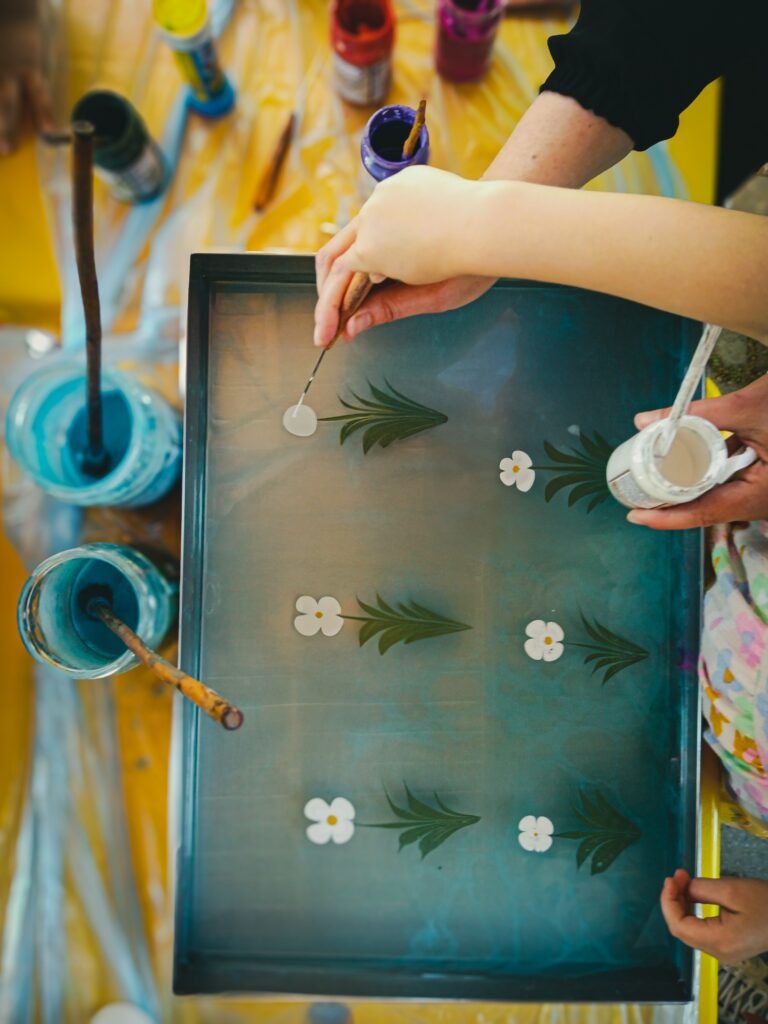
When a child has no template to follow, they have to make decisions. What colour? How much? What next? If I mix these what will happen? These micro-decisions, made hundreds of times across a creative session, are exactly the cognitive work of creative thinking. The child is generating options, evaluating them, choosing, executing, and adapting. This is problem-solving — the same cognitive process that will serve them in mathematics, science, writing, and every domain of human endeavour.
Product art offers none of this. When the template has already decided what color the sky should be, the child’s creative brain is not needed.
Intrinsic motivation and the love of making things
Children who do process art regularly develop an intrinsic relationship with the act of making — they create because creating is satisfying, not because the result will earn praise. This is one of the most valuable things a child can develop: the ability to be motivated from within, to pursue something because it genuinely matters to them, regardless of how it looks to anyone else.
Product art, by contrast, is almost entirely driven by external motivation — the approval of the finished result, look on the parent’s face, and the thing on the fridge. When that external validation is removed, the motivation evaporates. This is why children who have only done product art often say ‘I can’t draw’ and mean ‘I can’t draw in a way that looks right.’ The bar they are measuring themselves against is always someone else’s standard.
Confidence and self-efficacy
A child who decides what to make and then makes it has had an experience of being genuinely capable. They set the intention, executed the plan, and produced something that was entirely their own. This feeling — I made something that came from me — is one of the most powerful confidence-builders available to a young child.
A child who colours inside someone else’s lines has had a different experience: they have done something correctly, which is not the same thing. Correctness is measured against an external standard. Capability is measured against their own intention.
Concentration and sustained attention
Children in genuine process art experiences concentrate for far longer than children doing product art. The reason is simple: they are genuinely engaged and are making real decisions, encountering real surprises, and doing real creative work. The attention is self-generated rather than externally maintained.
This is the same principle behind the Montessori work cycle. Genuine engagement, freely chosen, generates the deepest and most sustained concentration available to a young child.
Emotional expression and regulation
Art is one of the oldest human tools for expressing what cannot be said in words. For young children who are still developing verbal communication, the ability to express emotion through colour, mark-making, and physical creation is not just nice to have — it is genuinely important. Process art gives children this tool. Product art gives them someone else’s emotional territory to stay within.
What Is Wrong With Product Art?
Nothing is wrong with product art as an occasional activity, a party craft, a seasonal decoration. The problem is when it becomes the default — when it is all a child ever does in the name of art, because it is tidier, more predictable, and produces something the parent can put on the fridge.
Here is what product art teaches, sometimes without anyone intending it to:
- There is a correct way to make something, and your job is to find it
- Your creative instincts are less reliable than the template
- Art is a performance of competence, not an expression of self
- If it does not look like the example, it has not worked
- Creativity is something other people have — your job is to follow their lead
These are not benign lessons. A child who internalises them does not just struggle with art. They struggle with any creative or open-ended task where there is no clear right answer — which includes most of the interesting problems in adult life.
The child who is told to colour the sun yellow because that is the correct colour loses something small and something large at the same time. The correct colour. And the idea that they get to decide.
The Comparison — Side by Side
Here is the difference laid out directly, for reference:
| Aspect | Process Art | Product Art |
| Who leads | The child — entirely | The adult or template |
| Goal | The experience itself | A specific finished object |
| Outcome | Unique every time | Predictable, similar to the model |
| Skills built | Creativity, decision-making, self-expression, problem-solving | Fine motor execution, instruction-following |
| Motivation | Intrinsic — the child is the point | Extrinsic — the result is the point |
| What it says | Your ideas have value | The template has value |
| Mess level | Usually significant | Usually contained |
| Time on task | Often long and absorbed | Usually shorter, more goal-focused |
| What the child learns | I am creative. I can make something from nothing. | I can follow instructions well. |
But What About Teaching Techniques?
This is the question that always comes up, and it is a fair one. Does process art mean children never learn how to hold a brush, mix colours, or develop any technical skill? Are we just letting them splash paint around indefinitely and calling it education?
No. But there is a right order to things.
Technical skills in art — brush control, colour theory, composition, mark-making — are best taught in response to what a child is already doing, not before they have had the chance to discover for themselves what art can do. A child who has spent months exploring paint freely will arrive at a lesson about brush technique with genuine curiosity and receptivity, because they have already encountered the problem the technique solves. A child who is given technique before experience just learns to execute someone else’s solution to a problem they have not yet noticed.
The Montessori approach to teaching any skill follows this principle: experience first, technique when it serves the experience. A child who has discovered that their lines are wobbly and wants to make them straighter is ready to learn about ruler use. And other child who has never had the experience of wanting straight lines has no reason to care about the skill.
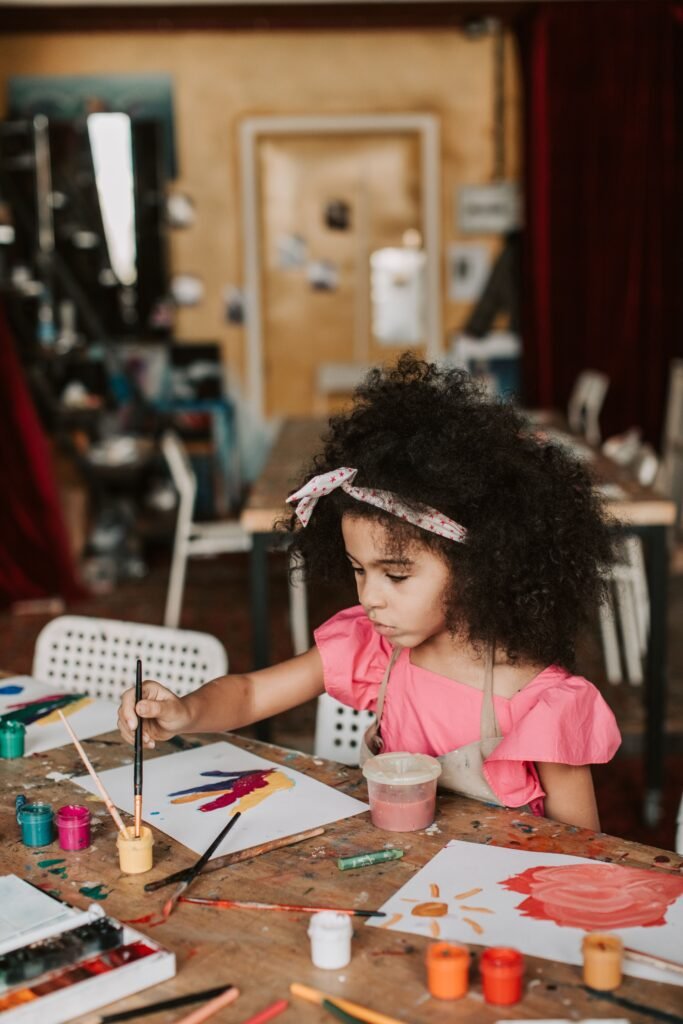
Technique taught to a curious child is absorbed eagerly. Technique taught to a child who has never wondered about it is just another instruction to follow.
What Montessori Art Actually Looks Like
In a Montessori environment, art is not a separate subject with a scheduled time and a pre-set outcome. It is woven into the prepared environment as one of several areas the child can choose freely. The art shelf holds materials — good quality watercolours, paper in different sizes and textures, chalk, pastels, collage materials, clay — and the child accesses them independently.
There is no art lesson, in the traditional sense , no ‘today we are making Easter chicks.’ Just a rich, well-stocked environment, time, and trust.
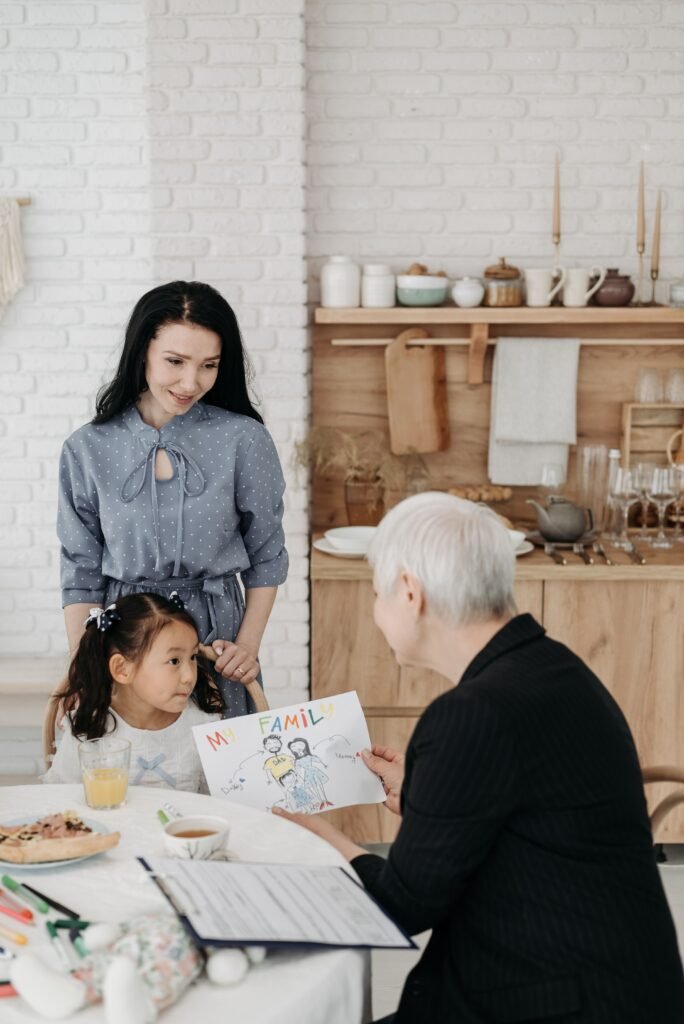
The Montessori teacher — and the Montessori parent — has a very specific role in this. It is to prepare the environment, step back, and resist the urge to direct. When a child shows you their creation, the Montessori response is not ‘that’s beautiful!’ — which is an evaluation, and evaluations train children to seek evaluations. A Montessori response is ‘tell me about this.’ Which is an invitation, and invitations train children to have something to say about their own work.
That difference — between ‘that’s beautiful’ and ‘tell me about this’ — is the whole philosophy in a sentence.
‘Tell me about this’ is possibly the most useful phrase in a parent’s creative vocabulary. It says: your work has meaning, you are the one who knows what it is, and I am genuinely interested. All three of those things matter enormously.
How to Bring More Process Art Into Your Home
You do not need an art room. You do not need expensive materials. You need a protected surface, some good basic supplies, and the willingness to let what happens happen without directing it.
A few practical things that make process art work at home:
Set up the invitation, then leave
Put out materials in an appealing, accessible way — paper on the table, a few pots of paint, some brushes of different sizes. Do not explain what to make. Do not demonstrate. Just set it up and let your child discover it. If they are old enough, they can set it up themselves. The act of preparing the space is part of the creative process.
Protect the surface, not the child from the mess
Cover the table with newspaper or an old sheet. Put an old shirt on the child. And then let them get as messy as the work requires. The mess is not a problem to be managed — it is evidence of genuine engagement. A child who is afraid of getting paint on their hands is a child who cannot lose themselves in the work.
Keep the materials consistent and accessible
Rather than producing a big art project once a month, make art materials a regular, accessible part of daily life. A low shelf with a few quality art supplies that the child can access independently signals that making things is a normal, everyday activity — not a special occasion that requires adult permission and supervision.
Respond to the process, not the product
When your child shows you what they made, resist the impulse to evaluate it. Instead, get curious. ‘What was the most fun part of making this?’ ‘How did you decide to use so much purple?’ ‘What happened when you mixed those two colours?’ These questions say something important: the experience you had matters, not just the thing you produced.
Do not compare, display, or assess
Process art is not for the fridge. Or rather — not primarily. Some of it might end up there, but the display is not the point and should not become the measure. If a child’s creative work is always evaluated by whether it makes it to the fridge, they will start making things fridge-worthy rather than things that interest them. The two are not always the same.
A Note on Age
Every age group can do process art — but what it looks like changes significantly across the early years:
- Under 2 — it is almost entirely sensorial. The child is interested in what paint feels like, what happens when they press their hand into it, what the brush does when it moves. There is no intention to represent anything. The experience is the whole point.
- Ages 2 to 3 — children begin to make intentional marks and may narrate what they are doing while they do it. Often the narrative shifts mid-session — what started as a dog becomes a house becomes a pattern. This is not inconsistency. It is creative thinking in action.
- Ages 3 to 5 — representational art begins to emerge. Children may intend to draw a person, a house, a dog, and produce something that requires imagination to interpret. This is completely normal and should be celebrated exactly as it is. The representation is inside their head. What comes out on paper is their current best attempt to bridge that gap.
- Ages 5 and older — children begin to be aware of how their work looks to others, and self-criticism often emerges at this stage. This is when the environment around art matters most — when the messages ‘there is no right way’ and ‘your ideas have value’ need to be most consistently reinforced.
The biggest risk at every age, but especially from five onward, is the child who internalises the idea that they ‘cannot draw.’ This idea almost never comes from inside the child. It comes from comparison — to a sibling, a classmate, a parent’s expectation. And once it takes hold, it is genuinely difficult to shift.
Process art, done consistently from an early age, is one of the best protections against it. But some art materials contain both creativity and process. I personally know few books that not only let kids to choose colors freely but also provide enough space to draw their observation and thinking about any object. It contains tell me about this element and make kids think as well as draw confidently. Here is the link:
What About Craft Activities? Are They All Bad?
Not at all. There is a place for structured craft activities — making something for Eid, assembling a birthday card, following a pattern. These things have social value, practical purpose, and are genuinely enjoyable for many children.
The issue is proportion and framing. If structured craft is a small part of a creative diet that also includes substantial amounts of open-ended process art — fine. Or If structured craft is all a child ever does in the name of creativity — something important is missing.
The same applies to colouring books. Colouring within pre-drawn lines has some value as a fine motor activity. It has very limited value as a creative one. A child who spends all their art time colouring inside someone else’s lines is not developing as a creative thinker. They are developing as a very careful executor of other people’s designs.
Give both. But weight the balance toward process. Your child’s creative life will be richer for it.
Art Materials Worth Having at Home
Good materials make a real difference to the quality of process art experience. Here are the ones worth investing in — chosen because they are open-ended, durable, and genuinely engaging for young children:
For Painting and Colour Exploration
- Crayola Washable Kids Paint — 10 Colour Set — Bright, washable, and genuinely good quality for the price. Washable paint removes the anxiety around mess — which removes the barrier to genuine creative engagement. Ten colours gives children enough range to discover mixing without overwhelming them.
- Melissa and Doug Easel Paper Roll — Large-format paper changes the scale of what a child can make — and larger scale often produces more expressive, more absorbed work. A roll means there is always more paper, which removes the scarcity pressure that makes children tentative. Pair with a basic easel or tape to a wall.
- Solid Tempra Paint Sticks — Higher quality crayons produce richer colour and respond more sensitively to pressure — which gives children more tactile feedback and more expressive range. The difference between cheap crayons and good ones is significant enough to notice immediately.
For Collage, Mixed Media and Open-Ended Making
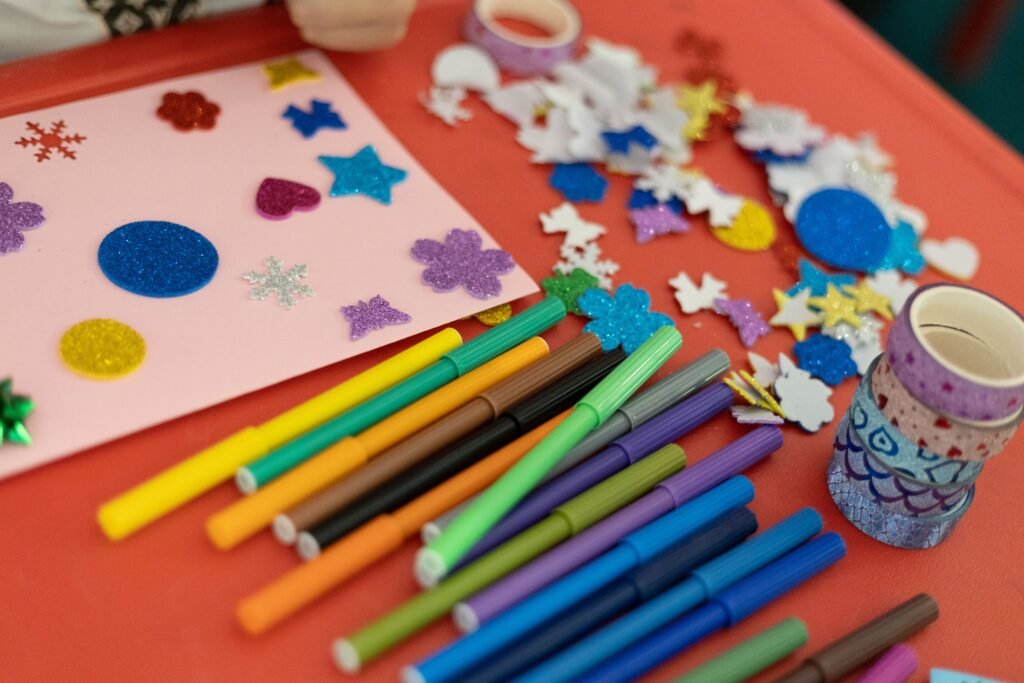
- Creativity for Kids Craft Supply Kit — 500+ Pieces — A well-stocked loose parts kit — feathers, buttons, foam pieces, pipe cleaners, pom-poms — gives children the raw material for genuinely open-ended collage and mixed media work. The variety means every session produces something different. Store in a sectioned container at child height for independent access.
- Jetec Wooden Pencil Pen Holder for Desk — the wooden pencil holder for desk is handmade from durable natural pinewood. It helps children to organize their color asseccories comfortably.
Most open-ended Montessori materials — the Constructive Triangles, loose parts collections, and sensorial materials — also function as process art materials when given to children with freedom and time. The creative potential of authentic Montessori material is always broader than its named purpose. All available at ksmontessori.com.pk.
Questions That Come Up
My child always asks me ‘what should I make?’ Is that a problem?
Not a problem — a habit. A child who consistently asks what to make has been trained by experience to expect direction before beginning. The solution is not to answer the question differently but to gently reshape the expectation over time. Try: ‘I wonder what you are in the mood to make today.’ Or: ‘I don’t know — what are you curious about?’ Or simply: ‘Anything you want.’ Sit with the discomfort of the silence that follows. The answer will come. It just takes time when the habit of waiting for instruction is strong.
My child’s process art looks like nothing. Should I be concerned?
No. Early process art is not representational. It is not supposed to look like a house or a person or a dog. It looks like paint and marks and colour and whatever the child’s hands did with the materials they had. That is not failure. That is genuine, age-appropriate creative expression. The representation comes later, when the child is ready for it — and it comes much more fully and confidently in children who have had extensive process art experience than in children who have mostly followed templates.
What do I say when my child shows me their process art?
The single best response: ‘Tell me about this.’ It works at every age, for every type of art, for every result. It places the child as the expert on their own work, it invites language and reflection, and it sidesteps the evaluation trap entirely. If they say ‘it’s just paint’ or ‘it doesn’t look like anything’ — ‘That’s okay. How did it feel to make it?’ is the follow-up. The experience is always worth discussing, even if the product is not worth explaining.
My child only wants to do colouring books. How do I introduce process art?
Slowly and without pressure. Put out a process art invitation alongside the colouring book — not instead of it. Let the child choose. Most children, given access to open-ended materials with no instructions and no expected outcome, will gradually explore them. Do not make a point of it. Just keep making the invitation available. The colouring book is the known thing. The open materials are the unknown. Curiosity will eventually win — it almost always does, with children.
The Mess Is the Point
I want to end with something that is easy to say and hard to live by, especially in homes where the kitchen table is also the homework table and the craft corner is also the living room floor.
The mess is the point.
Not the mess for its own sake — not chaos masquerading as creativity. But the genuine, absorbed, paint-everywhere mess that comes from a child who has completely lost themselves in making something. That mess is evidence. It is evidence that concentration happened, that creative decisions were made, that a small person trusted their own ideas enough to follow them into uncertain territory.
It wipes up. The concentration does not. The creative confidence does not. The memory of being given paint and space and complete freedom and making something that came entirely from inside them — that does not wipe up either.
Give them the mess. It is worth it.
More at kiransaifmontessori.com | Montessori materials at ksmontessori.com.pk
Tags: Process Art, Product Art, Montessori Art, Creative Development, Child Art Activities, Open-Ended Art, Creativity Kids, Art Education Children, Montessori at Home, Child Development, Early Childhood Creativity