Process Art vs Product Art:Which One Actually Helps Your Child?
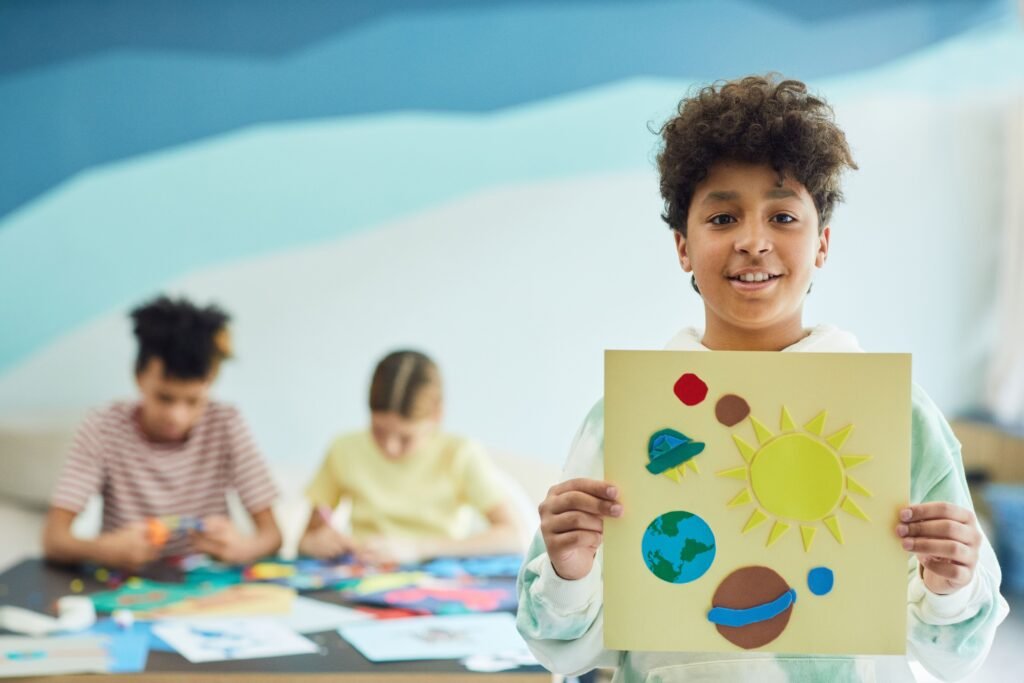
“A Montessori perspective on creative development — and why the mess matters more than the masterpiece“ Picture two scenes. In the first one, a four-year-old sits at a table covered in newspaper. In front of her are three pots of paint, a large sheet of white paper, and no instructions whatsoever. She starts by dipping her brush in the blue. Then she uses her finger and discovers that mixing blue and yellow makes something interesting happen. She spends twenty-five minutes doing this, completely absorbed, occasionally humming. The painting she produces looks, to an adult eye, like an energetic mess. To her, it is exactly what she wanted. In the second scene, a four-year-old sits at a table with a printed outline of a butterfly. He has been told which sections to colour in which colour. He works carefully within the lines. When he finishes, the butterfly looks like the example the teacher held up. His parent puts it on the fridge. Both children made art today. But only one of them actually did. That is the difference between process art and product art. And understanding it — really understanding it, not just as a theory but as a lived choice you make every time you sit your child down with a paintbrush — changes how you think about creativity, learning, and what art is actually for. So What Exactly Is the Difference? Process art Process art is child-led, open-ended creative experience where the activity itself is the point. There is no template to follow, no correct outcome, no example to replicate. The child decides what to make, how to make it, when it is finished, and what it means. An adult’s role is to provide materials, space, and enough trust to step back and let the exploration happen. It looks messy or may be often looks like nothing in particular. You cannot always tell what it is supposed to be — and that is completely fine, because it is not supposed to be anything. It is supposed to be whatever the child’s hands and mind made of the materials they were given. Product art Product art is adult-led, outcome-focused creative activity where the goal is a specific, predetermined result. The child follows a template, copies a model, colours within provided lines, or assembles pre-cut pieces. An adult has decided in advance what the finished piece should look like and child’s job is to execute the plan. It often looks impressive. Parents can immediately tell what it is. It photographs well and fills the fridge for a few weeks. And it teaches the child almost nothing about creativity, expression, or their own capacity for original thought. A child who has only ever done product art learns that art is something other people design and they execute. A child who has done process art learns that art is something they invent. These are not the same lesson. Why Process Art Matters — What It Actually Builds This is not just a philosophical preference. Process art builds specific, measurable capacities in young children that product art simply does not — and some that product art actively undermines. Here is what the research and the developmental science say: Creative thinking and problem-solving When a child has no template to follow, they have to make decisions. What colour? How much? What next? If I mix these what will happen? These micro-decisions, made hundreds of times across a creative session, are exactly the cognitive work of creative thinking. The child is generating options, evaluating them, choosing, executing, and adapting. This is problem-solving — the same cognitive process that will serve them in mathematics, science, writing, and every domain of human endeavour. Product art offers none of this. When the template has already decided what color the sky should be, the child’s creative brain is not needed. Intrinsic motivation and the love of making things Children who do process art regularly develop an intrinsic relationship with the act of making — they create because creating is satisfying, not because the result will earn praise. This is one of the most valuable things a child can develop: the ability to be motivated from within, to pursue something because it genuinely matters to them, regardless of how it looks to anyone else. Product art, by contrast, is almost entirely driven by external motivation — the approval of the finished result, look on the parent’s face, and the thing on the fridge. When that external validation is removed, the motivation evaporates. This is why children who have only done product art often say ‘I can’t draw’ and mean ‘I can’t draw in a way that looks right.’ The bar they are measuring themselves against is always someone else’s standard. Confidence and self-efficacy A child who decides what to make and then makes it has had an experience of being genuinely capable. They set the intention, executed the plan, and produced something that was entirely their own. This feeling — I made something that came from me — is one of the most powerful confidence-builders available to a young child. A child who colours inside someone else’s lines has had a different experience: they have done something correctly, which is not the same thing. Correctness is measured against an external standard. Capability is measured against their own intention. Concentration and sustained attention Children in genuine process art experiences concentrate for far longer than children doing product art. The reason is simple: they are genuinely engaged and are making real decisions, encountering real surprises, and doing real creative work. The attention is self-generated rather than externally maintained. This is the same principle behind the Montessori work cycle. Genuine engagement, freely chosen, generates the deepest and most sustained concentration available to a young child. Emotional expression and regulation Art is one of the oldest human tools for expressing what cannot be said in words. For young children who are still developing verbal communication, the ability to express emotion through colour, mark-making, and
My Child Won’t Share and Hides
Behind My Legs at Parties — Is Something Wrong? A Warm, Honest Guide for Parents of Shy Children and Reluctant Sharers | kiransaifmontessori.com The birthday party is in full swing. Every other child is running, shouting, grabbing cake, and making instant friends. Your child is pressed firmly against your leg, face buried in your side, absolutely certain they are not coming out until it is time to go home. Later, at the park, another child reaches for your toddler’s favourite digger. Your child snatches it back so fast it makes everyone flinch. No negotiation. No warning. Just a very clear: that is mine. You smile apologetically at the other parent, feel the familiar mix of embarrassment, worry, and love and wonder — is my child okay? Is something wrong? Should I be doing something differently? Here is the answer, and it is a good one: almost certainly, no. Both of these behaviours — shyness in social situations and reluctance to share — are completely normal parts of child development. They are not character flaws. They are not signs of bad parenting. They are signs of a child who is developmentally right on track. But normal does not mean you cannot help. And that is exactly what this guide is for. How to Help a Shy Child Build Confidence First — What Is Shyness, Really? Shyness is not a personality defect. It is not a sign that something has gone wrong. It is a temperament trait — a way of being in the world that some children are simply born with. Researchers estimate that around 15 to 20 percent of children are born with what psychologist Jerome Kagan called a ‘behaviourally inhibited’ temperament — meaning they are naturally more cautious, more sensitive to new stimuli, and slower to warm up to unfamiliar people and situations. This is biological. It is not something you caused. It is not something your child can simply choose to switch off. And crucially — it is not something that needs to be fixed. Shy children grow into thoughtful, perceptive, deeply empathetic adults who notice things that others miss and build fewer but profoundly deeper relationships. What parents can do is not eliminate shyness — but help their child move through it with confidence rather than being paralysed by it. There is a big difference between a shy child who feels supported and a shy child who feels ashamed of who they are. 🔬 Research Note: Studies by Dr. Jerome Kagan at Harvard found that while temperament is largely inborn, the environment makes an enormous difference to how it plays out. Shy children with warm, supportive, non-pressuring parents develop much better social outcomes than shy children who are pushed, labelled, or made to feel their shyness is a problem. The Things We Say That Make Shyness Worse Before we talk about what helps, let’s talk about what does not — because many of the instinctive things parents say in social situations can unintentionally make a shy child’s experience harder, not easier 😬 At a family gathering when a relative says hello ❌ What NOT to do: Pushing them forward: ‘Go on, say hello! Don’t be rude!’ or labelling them to the relative: ‘She’s shy, sorry.’ ✅ What works instead: Crouch down to your child’s level and say quietly: ‘It’s okay to feel shy. Take your time. I’m right here.’ Let them watch from the safety of your side until they are ready. Most shy children will engage — on their own timeline. 🌿 Montessori note: In Montessori we call this the sensitive period for warming up. Every child has their own pace of engagement with new people. Rushing it or shaming it does not accelerate it — it entrenches it. 🎂 At a birthday party where your child won’t join in ❌ What NOT to do: Separating from them before they are ready: ‘Go and play! You’ll be fine!’ or comparing them: ‘Look how all the other children are playing nicely.’ ✅ What works instead: Stay nearby and give a running, calm commentary: ‘There’s a sandpit over there. There’s a girl with a red dress building something.’ Let curiosity do the work. Do not push. When they are ready — and they usually are within 20 to 30 minutes — they will move toward the activity on their own. 🌿 Montessori note: The Montessori prepared environment principle applies here too. A warm, predictable, low-pressure social setting where a child can observe before participating is the ideal environment for a shy child to flourish. 🧒 When another adult asks your child a direct question ❌ What NOT to do: Answering for them immediately or pressuring: ‘Answer Aunty! Tell her your name!’ ✅ What works instead: Give your child a moment of silence — longer than feels comfortable. If they genuinely cannot respond, say gently: ‘He knows his name. He might need a moment.’ Then move the conversation on. Never answer for them unless they have clearly indicated they want you to. 🌿 Montessori note: Answering for a child repeatedly teaches them that they do not need to speak for themselves — which is the opposite of the independence and confidence we are trying to build 10 Gentle Ways to Help a Shy Child Build Real Confidence These are not tricks or hacks. They are genuine, research-informed, Montessori-aligned approaches that build confidence from the inside out — not a performance of confidence that falls apart when the pressure is on. Never Label Them as Shy — In Front of Them or Anyone Else The moment you say ‘she’s shy’ in front of your child, you have given them a story about themselves that they will carry and live up to. Children become what we name them. Instead of ‘she’s shy’, try ‘she takes a little time to warm up — she’ll get there.’ That is a story about a process, not a permanent identity. It leaves the door open. Try saying: “She is still getting comfortable. Give
Gentle Discipline for 2-Year-Olds:Positive Techniques That Actually Work
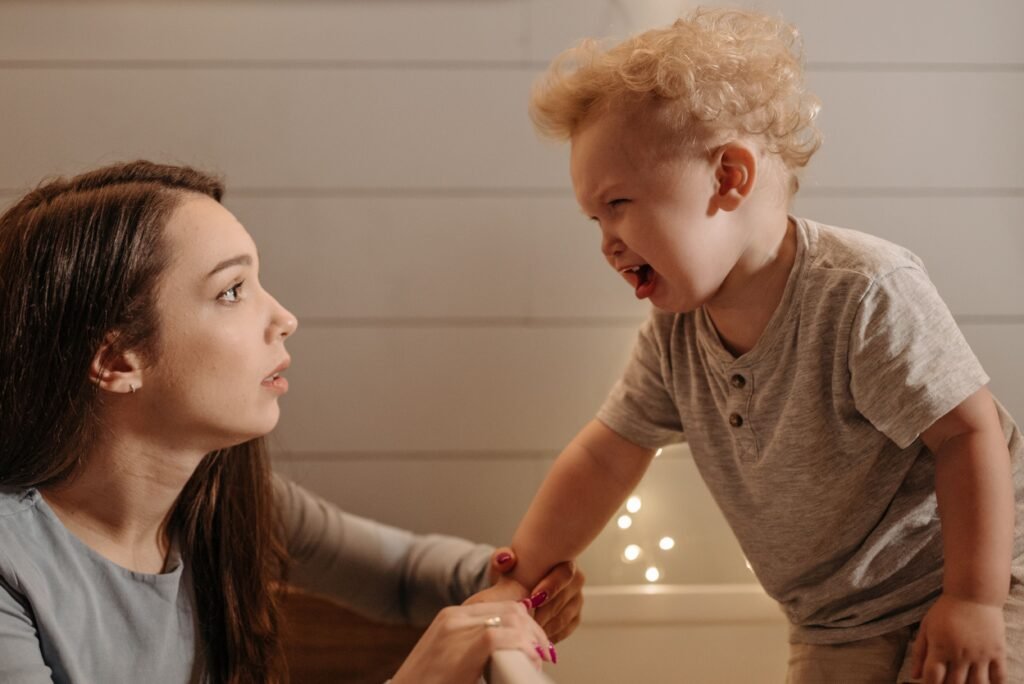
A Real Parent’s Guide — With Everyday Examples and Scripts By Kiran Saif | Certified Montessori Educator | kiransaifmontessori.com It is 8am. Your two-year-old has just thrown their cereal bowl on the floor because the spoon was the wrong colour. Not the wrong spoon — the wrong colour. Yesterday they did the same with their shoes because you put the left one on first instead of the right. You love this child with every cell in your body. And right now, in this moment, you genuinely do not know what to do. This is two. Not terrible — just two. A two-year-old is not being naughty when they melt down over a spoon. They are being a perfectly normal human being whose emotional brain is fully switched on but whose thinking brain — the part that manages impulse control and rational thought — will not be fully developed until they are approximately twenty-five years old. That gap — between what a two-year-old feels and what they can manage — is where all the big emotions live. And gentle discipline is simply the art of helping your child bridge that gap, with compassion, with firmness, and without anyone losing their dignity. This guide gives you the understanding, the techniques, and the actual words to say — in everyday situations — so that discipline at two feels less like a battle and more like a partnership. First — Understanding Why Two-Year-Olds Behave the Way They Do Before we talk about what to do, it helps to understand what is actually going on inside your two-year-old. Because once you understand it, so much of the behaviour that feels maddening starts to make sense. Their brain is not fully connected yet The human brain develops from back to front. The back part — the emotional, reactive brain — is fully active from birth. The front part — the thinking, reasoning, impulse-controlling prefrontal cortex — is still very much under construction at age two and will not be complete until the mid-twenties. When your two-year-old has a tantrum, they are not choosing to be difficult. Their emotional brain has flooded, and the thinking brain that could calm them down is not yet powerful enough to do so. They genuinely cannot stop themselves in that moment — any more than you could stop yourself crying if you received devastating news. 🔬 The Science in Simple Words: When a child has a meltdown, their brain is in ‘alarm mode’. Shouting at them, lecturing them, or punishing them in this state does not teach anything — because the learning part of the brain has temporarily gone offline. What brings it back online is safety, connection, and calm. That is why gentle discipline works and harsh discipline does not. They are discovering they are a separate person Between 18 months and 3 years, children go through one of the most profound psychological developments of their lives: they discover that they are a separate person from their parents, with their own wants, preferences, and will. ‘No’ and ‘mine’ and ‘I do it myself’ are not defiance — they are declarations of selfhood. This is worth celebrating, even when it is exhausting. A child who pushes back is a child who is developing a healthy sense of self. Your job is not to squash that emerging identity — it is to channel it safely. They cannot yet manage their emotions Emotional regulation — the ability to feel a big feeling without being completely overwhelmed by it — is a skill. It is not innate. It is built, slowly, over years of experience, with the support of adults who model and scaffold it. At two, this skill is in its earliest infancy. When you stay calm during your child’s storm, you are literally teaching their brain how to regulate. Every time you say ‘I can see you are really angry’ instead of ‘stop crying right now’, you are building a neural pathway that will serve your child for life. 💛 The Most Helpful Reframe: Your two-year-old is not giving you a hard time. They are having a hard time. That shift in perspective changes everything about how you respond. What Gentle Discipline Actually Means — And What It Is Not Gentle discipline is one of the most misunderstood phrases in parenting. So let us be very clear about what it means — and what it absolutely does not mean. Gentle discipline IS: Setting clear, consistent limits — children need boundaries to feel safe Responding to behavior with curiosity rather than punishment — asking ‘what does my child need?’ instead of ‘how do I stop this?’ Staying calm yourself, even when it is hard — your calm is the most powerful tool you have Following through on what you say — gentle does not mean inconsistent Teaching skills rather than just stopping behavior — the goal is a child who can eventually regulate themselves Treating your child with the same respect you would want for yourself Gentle discipline is NOT: Permissive parenting — limits still exist, and they are firm Giving in to every demand to avoid a tantrum Endless negotiating with a two-year-old Never saying no Letting your child do whatever they want Being a pushover 🌱 The Montessori View: Dr. Montessori called it ‘freedom within limits’. The child has real freedom — to choose, to explore, to express themselves — within a clear, consistent, loving structure. The limits are not punishments. They are the shape of the safe space within which the child can grow. Gentle vs Harsh — Seeing the Difference in Real Situations Sometimes it helps to see the contrast clearly. Here are common two-year-old situations and how a harsh response compares to a gentle one: Situation Harsh Response ❌ Gentle Response ✅ Child hits another child “Stop it! That is naughty! Say sorry right now!” “Hitting hurts. I won’t let you hurt your friend. Let’s find another way.” Tantrum in the supermarket “Stop crying or