Behind My Legs at Parties —
Is Something Wrong?
A Warm, Honest Guide for Parents of Shy Children and Reluctant Sharers | kiransaifmontessori.com
The birthday party is in full swing. Every other child is running, shouting, grabbing cake, and making instant friends. Your child is pressed firmly against your leg, face buried in your side, absolutely certain they are not coming out until it is time to go home.
Later, at the park, another child reaches for your toddler’s favourite digger. Your child snatches it back so fast it makes everyone flinch. No negotiation. No warning. Just a very clear: that is mine.
You smile apologetically at the other parent, feel the familiar mix of embarrassment, worry, and love and wonder — is my child okay? Is something wrong? Should I be doing something differently?
Here is the answer, and it is a good one: almost certainly, no. Both of these behaviours — shyness in social situations and reluctance to share — are completely normal parts of child development. They are not character flaws. They are not signs of bad parenting. They are signs of a child who is developmentally right on track.
But normal does not mean you cannot help. And that is exactly what this guide is for.

How to Help a Shy Child
Build Confidence
First — What Is Shyness, Really?
Shyness is not a personality defect. It is not a sign that something has gone wrong. It is a temperament trait — a way of being in the world that some children are simply born with. Researchers estimate that around 15 to 20 percent of children are born with what psychologist Jerome Kagan called a ‘behaviourally inhibited’ temperament — meaning they are naturally more cautious, more sensitive to new stimuli, and slower to warm up to unfamiliar people and situations.
This is biological. It is not something you caused. It is not something your child can simply choose to switch off. And crucially — it is not something that needs to be fixed. Shy children grow into thoughtful, perceptive, deeply empathetic adults who notice things that others miss and build fewer but profoundly deeper relationships.
What parents can do is not eliminate shyness — but help their child move through it with confidence rather than being paralysed by it. There is a big difference between a shy child who feels supported and a shy child who feels ashamed of who they are.
🔬 Research Note: Studies by Dr. Jerome Kagan at Harvard found that while temperament is largely inborn, the environment
makes an enormous difference to how it plays out. Shy children with warm, supportive, non-pressuring parents develop much better social outcomes than shy children who are pushed, labelled, or made to feel their shyness is a problem.
The Things We Say That Make Shyness Worse
Before we talk about what helps, let’s talk about what does not — because many of the instinctive things parents say in social situations can unintentionally make a shy child’s experience harder, not easier
😬 At a family gathering when a relative says hello
❌ What NOT to do: Pushing them forward: ‘Go on, say hello! Don’t be rude!’ or labelling them to the relative: ‘She’s shy, sorry.’
✅ What works instead: Crouch down to your child’s level and say quietly: ‘It’s okay to feel shy. Take your time. I’m right here.’ Let them watch from the safety of your side until they are ready. Most shy children will engage — on their own timeline.
🌿 Montessori note: In Montessori we call this the sensitive period for warming up. Every child has their own pace of engagement with new people. Rushing it or shaming it does not accelerate it — it entrenches it.
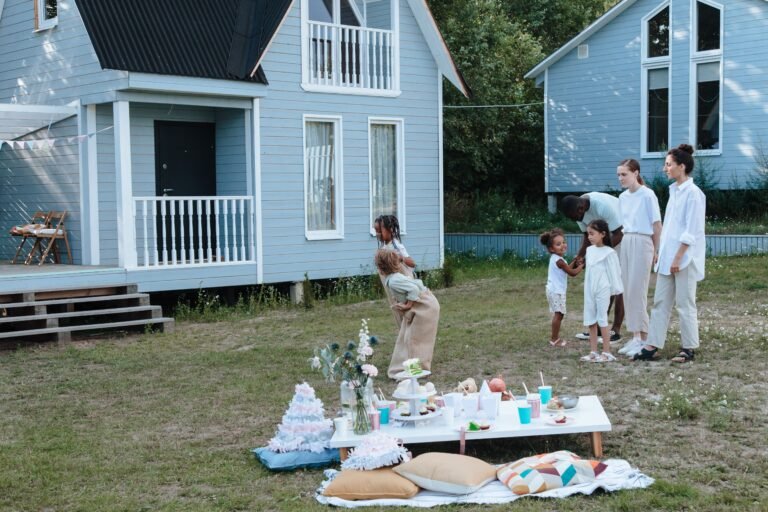
🎂 At a birthday party where your child won’t join in
❌ What NOT to do: Separating from them before they are ready: ‘Go and play! You’ll be fine!’ or comparing them: ‘Look how all the other children are playing nicely.’
✅ What works instead: Stay nearby and give a running, calm commentary: ‘There’s a sandpit over there. There’s a girl with a red dress building something.’ Let curiosity do the work. Do not push. When they are ready — and they usually are within 20 to 30 minutes — they will move toward the activity on their own.
🌿 Montessori note: The Montessori prepared environment principle applies here too. A warm, predictable, low-pressure social setting where a child can observe before participating is the ideal environment for a shy child to flourish.
🧒 When another adult asks your child a direct question
❌ What NOT to do: Answering for them immediately or pressuring: ‘Answer Aunty! Tell her your name!’
✅ What works instead: Give your child a moment of silence — longer than feels comfortable. If they genuinely cannot respond, say gently: ‘He knows his name. He might need a moment.’ Then move the conversation on. Never answer for them unless they have clearly indicated they want you to.
🌿 Montessori note: Answering for a child repeatedly teaches them that they do not need to speak for themselves — which is the opposite of the independence and confidence we are trying to build
10 Gentle Ways to Help a Shy Child Build Real Confidence
These are not tricks or hacks. They are genuine, research-informed, Montessori-aligned approaches that build confidence from the inside out — not a performance of confidence that falls apart when the pressure is on.
- Never Label Them as Shy — In Front of Them or Anyone Else
The moment you say ‘she’s shy’ in front of your child, you have given them a story about themselves that they will carry and live up to. Children become what we name them. Instead of ‘she’s shy’, try ‘she takes a little time to warm up — she’ll get there.’ That is a story about a process, not a permanent identity. It leaves the door open.
Try saying: “She is still getting comfortable. Give her a few minutes.”
- Always Prepare Them Before Social Situations
Shy children do significantly better in social situations when they know what to expect. Before a birthday party, a family gathering, or a new class — talk them through it. Who will be there. What will happen. How long you will stay. Where you will be. This is not coddling — it is removing the unknown, which is what shy children find most threatening. Information is power for a cautious child.
Try saying: “Today we are going to Amna’s house. There will be about five children there. I will stay the whole time. We will leave after the cake.”
- Let Them Warm Up — Never Rush or Force
Shy children are observers first and participants second. They need to watch, absorb, and feel safe before they step in. This can take anywhere from five minutes to forty-five minutes in a new situation — and that is completely fine. Your job is to stay nearby, stay calm, and let them move at their own pace. The child who watches the whole party from the sideline and then joins in for the last ten minutes is not failing — they are doing exactly what their temperament needs them to do.
4. Build Confidence Through Competence at Home
Confidence is not something you talk a child into. It is built through repeated experiences of being capable — of doing things for themselves, completing tasks, solving problems, and seeing that they can. A child who can pour their own water, dress themselves, cook something simple, and care for a plant arrives at social situations with a deeper sense of self than a child who has been done for in everything. Independence at home is the foundation of confidence everywhere.
- Role Play Social Situations at Home
Before a new social situation, practise it at home in a low-stakes, playful way. You be the child at the party, and they practise saying hello. You be the new child at the park, and they practise asking to join in. Play is how children rehearse for life — and a shy child who has practised the words ‘can I play?’ fifty times at home is far more likely to actually say them when the moment comes.
Try saying: “Let’s practise. I’ll be the new child. You say: can I play too?”
6. Find Their People in Small Groups
Shy children do not need a crowd. They need one good friend. Instead of large parties and busy classes where the social complexity is overwhelming, arrange smaller playdates — two children, your home, a familiar environment. One-on-one interaction is where shy children often shine brilliantly. Let them build deep friendships with one or two children rather than trying to make them the life of every party.
7. Acknowledge the Feeling Without Making It Bigger Than It Is
When your child clings to your leg, resist both the urge to dismiss (‘there is nothing to be scared of!’) and the urge to over-sympathise (‘oh, poor baby, is it scary?’). Both approaches make the feeling either invisible or enormous. Instead, acknowledge it matter-of-factly: ‘New places can feel a bit strange at first. That is normal. I am right here.’ Calm and warm, not dismissive and not dramatic.
Try saying: “New things can feel tricky. That makes sense. Take your time.”
- Let Them See You Being Brave
Children watch their parents constantly. When you introduce yourself to someone you do not know, when you try something new without making a big deal of it, when you handle an uncomfortable situation with calm — your child is watching and absorbing. You do not need to perform courage. You just need to let them see you living it.
- Read Books About Characters Who Are Shy
Stories are one of the most powerful tools for helping children understand themselves. When a child sees a character who hides behind their parent, who needs time to warm up, who eventually finds their courage on their own terms — they feel understood. They also see that shyness is something characters move through, not something they are stuck in forever. Ask your librarian for recommendations — there are many beautiful books on this theme.
- Trust the Long Game Most shy children grow into confident, capable people — not because they stopped being sensitive and cautious, but because they found ways to use those qualities as strengths. The child who watched from the sidelines becomes the adult who observes carefully before speaking and is trusted for it. The child who built one deep friendship becomes the adult who maintains relationships for decades. Shyness is not a problem to solve. It is a temperament to support.
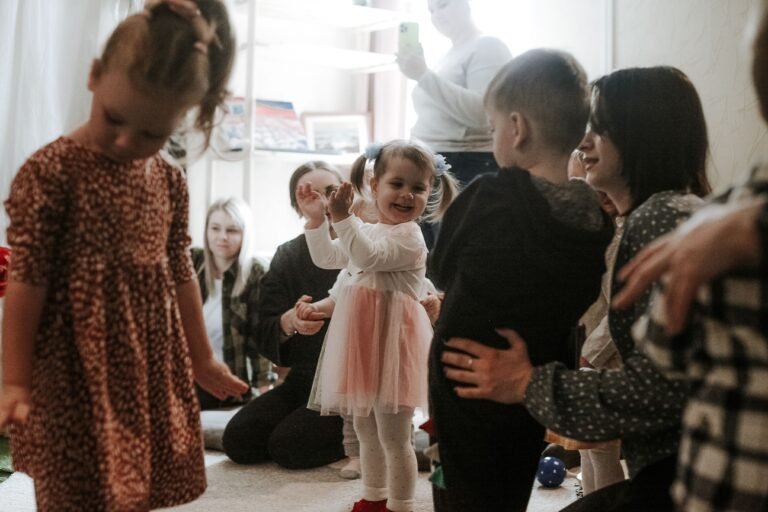
My Child Won’t Share —
Is That Normal?
The Truth About Sharing That Nobody Tells You
Here it is, plainly: genuine, voluntary sharing is a developmental milestone that most children do not reach until around the ages of three and a half to four — and many not until five or six.
Before that age, expecting a toddler to willingly hand over their favourite toy to another child is like expecting them to solve algebra. The brain simply is not there yet. The part of the brain responsible for impulse control, empathy, and deferred gratification — the prefrontal cortex — is not developed enough to make genuine sharing possible.
And yet we expect it. We apologise for it. We lecture toddlers about it in the middle of a playground while another parent watches. We force the handover, demand the apology, and wonder why nothing changes.
🔬 Developmental Fact: According to child development researcher Dr. Michael Tomasello, true prosocial sharing — giving something of value to another person because you genuinely want them to have it — does not emerge reliably until around age 3.5 to 4. Before that, what looks like refusing to share is actually developmentally appropriate ownership behaviour. The child is not being selfish. They are being two.
What if the problem is not our children — but our expectations?
🔬 Developmental Fact: According to child development researcher Dr. Michael Tomasello, true prosocial sharing — giving something of value to another person because you genuinely want them to have it — does not emerge reliably until around age 3.5 to 4. Before that, what looks like refusing to share is actually developmentally appropriate ownership behaviour. The child is not being selfish. They are being two.
Why Forcing Sharing Backfires
Most parents force sharing with the best intentions. They want to teach their child to be kind, generous, and socially aware. But research consistently shows that forced sharing actually produces the opposite outcome to what parents intend. Here is why:
- When you force a child to hand over their toy, they experience the interaction as loss and injustice — not generosity
- Forced sharing teaches compliance with social pressure, not genuine empathy or care for others
- Children who are regularly forced to share are often MORE possessive, not less — because they have learned that toys can be taken away at any moment
- The apology demanded immediately after (‘say sorry!’) is hollow — the child does not yet understand why they are apologising, so it teaches nothing
- It damages trust — if your child cannot trust that their belongings are safe, they grip them tighter, not looser
💛 The Montessori View on Sharing: In a Montessori classroom, we do not force sharing. When a child is using a material, it is theirs until they are finished. Another child who wants it waits. This teaches something far more valuable than forced sharing: patience, respect for others in their work, and the understanding that their turn will come. Real social development — not performance.
What to Do Instead of Forcing — What Actually Works
So if forcing does not work, what does? Here are the approaches that genuinely build sharing behaviour over time — not through compulsion, but through genuine social and emotional development:
- Teach Turn-Taking Instead of Sharing
Turn-taking is cognitively and emotionally more manageable than sharing because it has a clear structure: you have it, then I have it, then you have it again. It is predictable, fair, and achievable for most children from about age two onwards. Give it a name — ‘your turn, my turn’ — and use it consistently in daily life: taking turns talking, taking turns picking a book, taking turns with the TV remote. When it is a familiar concept at home, it becomes available in social situations.
Try saying: “It is Zara’s turn right now. When she is finished, it will be your turn. I will help you wait.”
- Use a Timer
Abstract waiting is very hard for young children. A visual timer makes waiting concrete and manageable — the child can see how much time is left. Set a timer for two or three minutes (start short), and when it goes off, the toy changes hands. Both children experience this as fair and predictable. Over time, they often begin regulating themselves: ‘is it my turn yet?’ rather than snatching.
Try saying: “The timer is on. When it beeps, it will be your turn. Can you watch and wait?
- Give Special Objects Protected Status
One of the most effective sharing strategies is also the simplest: before a playdate, let your child put away any toys that are too precious to share. Choosing what to protect and what to make available gives the child genuine autonomy and reduces the desperation that leads to snatching and tears. A child who knows their most beloved toy is safe in their room is a child who can be more generous with everything else.
Try saying: “Before your friend comes, let’s put your special rabbit somewhere safe. Everything on this shelf is for sharing today.”
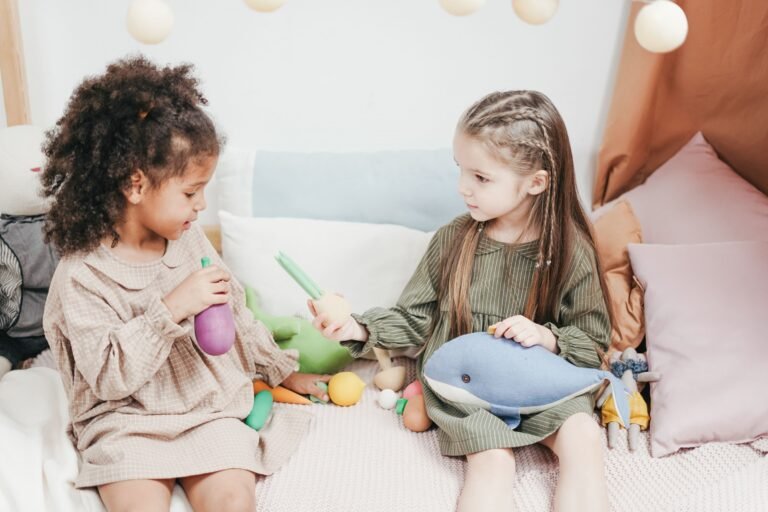
- Narrate and Coach — Do Not Lecture
In the moment of conflict, the child’s brain is flooded and not receptive to lessons. What helps is calm, specific narration: ‘Omar has the truck right now. You want the truck. That is hard to wait for. Let’s find something else while we wait.’ Keep it simple, keep it warm, keep it factual. Save the longer conversation — ‘when we share, it makes our friends feel good’ — for a calm moment later, not the heat of the battle.
Try saying: “I can see you both want that. Let’s figure this out together.”
- Praise Genuine Sharing When It Happens Naturally
When your child shares spontaneously — even once, even a small thing — name it specifically and warmly: ‘You gave Layla some of your crackers. That was really kind.’ Not ‘good boy/girl’ — specific praise about the specific action. This builds the identity ‘I am someone who shares’ far more effectively than any amount of lecturing or forcing.
Try saying: “You gave her a piece of your biscuit. That was a really kind thing to do.”
- Model Generosity Constantly
Children learn what they live. If they see you sharing, offering, giving — without drama, without keeping score — they absorb that as the normal way humans behave. Share your food. Offer things before being asked. Say ‘would you like some of this?’ when you have something they would enjoy. Your daily behaviour is your child’s most powerful teacher.
- Read Books About Sharing and Taking Turns
Just as with shyness, stories are extraordinarily powerful here. When children see characters struggle with sharing and find their way through it, they develop the narrative and the vocabulary to make sense of their own experience. Look for books that treat the struggle honestly rather than presenting sharing as effortlessly wonderful — children recognise and trust the honest version.
The Surprising Connection Between Shyness and Sharing
Here is something worth noticing: both shyness and reluctance to share come from the same root — a need for safety and control in a world that feels uncertain.
A shy child hangs back because the social world feels big and unpredictable. A child who will not share grips their toy because their sense of ownership and security feels fragile. In both cases, the child is not being difficult. They are managing vulnerability in the only ways their developing brain knows how.
The response to both is the same — not pressure, not shame, not force, but connection, patience, and the gradual, supported building of the skills and security that make social confidence possible.
A child who feels safe is a child who can be brave. A child who feels their belongings are respected is a child who can be generous. Safety and respect are not luxuries in parenting — they are the soil in which everything else grows.
🌱 The Montessori Principle Underneath Both: In Montessori, we say: never help a child with a task at which they can succeed alone. The same applies to social development. Our job is not to manage our children’s social lives for them — it is to create the conditions in which they can develop their own social capabilities, at their own pace, with our support always available but never imposed.
When Should You Be Concerned?
Most shyness and most sharing struggles are completely normal. But there are times when it is worth seeking a professional opinion — not with alarm, but with care:
About shyness — speak to your paediatrician if:
- Your child’s shyness is so extreme that it prevents them from functioning — they cannot attend school, they cannot be in any social situation, they are in visible distress every day
- The shyness seems to be getting significantly worse over time rather than gradually easing
- Your child is expressing strong fear or anxiety about social situations that goes beyond typical wariness
- Your child has lost social skills they previously had
- You have any concerns about social communication — difficulty with eye contact, difficulty reading social cues, very limited interest in other children
About sharing — speak to your paediatrician if:
- Your child is five or older and still has significant difficulty with turn-taking and sharing in ways that affect their friendships and school relationships
- The behaviour around sharing is accompanied by significant aggression — hitting, biting, extreme distress
- Your child shows very limited empathy or interest in the feelings of others more broadly
💛 A Word of Reassurance: The vast majority of parents reading this guide do not need to worry. They have a shy child who is perfectly healthy and will grow into a thoughtful adult. They have a toddler who does not share yet because they are developmentally not meant to yet. Both are normal. Both are temporary. Both are manageable with patience, warmth, and the right approach.
Montessori Materials That Build Social Confidence and Generosity
The right materials build the inner resources — confidence, independence, concentration, and a sense of competence — that make social skills like sharing and brave engagement far more accessible. Here are our top picks from KS Montessori:
For Building Confidence and Independence
- Dressing Frames — A child who can dress themselves is a child who believes they are capable. That deep sense of competence — built through Practical Life mastery — is the foundation of social confidence. Start here for shy children.
Montessori Shelf — Wooden Toy Storage Organizer — A prepared environment where everything has a place and the child is in charge of their own space builds the sense of order and ownership that makes a child feel secure — and a secure child is a braver, more generous one
- Kids Cleaning Set — 8 Pcs — Purposeful, real work builds the self-esteem that underlies confidence in every area of life. A child who contributes to their household has a sense of purpose and belonging that they carry into every social situation.
For Building Turn-Taking and Social Play
- Wooden Stacking Rings for Toddlers — Simple, beautiful, and easy to take turns with. One ring at a time, one child at a time — stacking rings make turn-taking concrete, manageable, and fun from as young as 18 months.
- Multiple Shapes Knob Wooden Puzzles — Self-correcting puzzles that children can do side by side — parallel play that gradually shifts to cooperative play. Shy children often find parallel activity the easiest first step into social engagement.
- Busy Board Montessori Toys for Toddler — Independent, absorbing fine motor activity that builds the focused concentration and calm self-sufficiency that confident, generous children carry into all their interactions.
For Cognitive and Emotional Development
- Counter Cards and Counters — Counting and sorting activities that children can do independently or alongside a friend — a natural bridge between solitary and cooperative play that is ideal for shy children building social confidence at their own pace.
- Constructive Triangles — Open-ended shape building that works beautifully as a shared activity — two children building together, each with their own triangles, naturally practising turn-taking and collaborative creation without it being imposed.
- Object Permanence Box — For younger children, cause-and-effect play builds the cognitive predictability and confidence in how the world works that is the earliest foundation of social trust and engagement.
🛒 Shop All Materials: All materials above are available at kiransaifmontessori.com and ksmontessori.com.pk — chosen to build the confidence, independence, and social capability that shy children and reluctant sharers need to flourish in their own time and their own way.
Questions Parents Ask Most
Will my shy child will always be shy?
Temperament is relatively stable — a child who is cautious and slow to warm up will probably always have some of that quality as an adult. But what changes dramatically is how much it limits them. With the right support, shy children develop strategies and confidence that allow them to navigate social situations comfortably — even if they still prefer a quiet dinner with one good friend over a party of fifty. That is not a problem. That is a personality.
My child shares fine with me but not with other children. Why?
This is completely normal. Sharing with a parent is safe — there is no threat of loss, because the parent will always give it back. Sharing with another child is different — the child does not yet fully trust that they will get it back, that it will come back undamaged, or that the social exchange is fair. Trust between peers builds gradually with repeated positive experiences. Keep arranging low-pressure play opportunities and it will develop.
Other children the same age share without any problem. Is my child behind?
Children develop at different rates, and what looks like effortless sharing in another child may be compliance born of anxiety — children who are conflict-avoidant will hand over a toy to avoid a scene, but that is not genuine generosity. It is also worth remembering that you only see a snapshot of other children in social situations. Their parents are often sitting at home worrying about something else entirely.
My child is shy at school but completely different at home. Is that okay?
Very common and very normal. Many children — particularly those who are highly sensitive or introverted — use their home environment to recharge and decompress after the social demands of school. The child who is loud, bossy, and exuberant at home while being quiet and watchful at school is not being two-faced. They are managing a very high-demand social environment all day and coming home to let it all out. That is healthy. Give them the space for it.
Your Child Is Not Broken — They Are Becoming
The child who hides behind your leg at the birthday party is not failing at childhood. They are doing exactly what their temperament and their developing brain require them to do — observing carefully, managing their own sense of safety, and deciding in their own time when the world is safe enough to step into.
The child who snatches back their toy without a moment’s hesitation is not being selfish. They are being two — with a concrete, healthy sense of ownership and none of the neurological development yet required for genuine voluntary generosity.
Both of them are normal. Both of them are on their way. Both of them need the same thing from you: patience, warmth, genuine belief in who they are, and the confident knowledge that you are not going to shame them for being themselves.
That is, in the end, what all children need. And it is the most Montessori thing of all — trusting the child. Following the child. Believing that given the right environment and the right support, they will get where they need to go.
Your job is to stay close while they do. They will.
Explore Montessori materials: kiransaifmontessori.com
Written for kiransaifmontessori.com