Best Montessori Learning Material At Home
Close your eyes for a moment and imagine tracing your finger along the raised, rough surface of a letter. You feel its curves, its angles, the direction it travels. Now imagine doing that dozens of times, day after day, with no pressure — only curiosity and the simple pleasure of touch. By the time you sit down to write that letter, your hand already knows the way.
This is the quiet genius of the Montessori Sandpaper Letters — one of the most beloved and effective materials in early childhood education. Simple in appearance, profound in impact, these rough-textured letter tiles have helped generations of children unlock the mysteries of reading and writing in a way that feels entirely natural, unhurried, and joyful.
In this blog post, we explore what Sandpaper Letters are, the science behind why they work so powerfully, how to use them at home, and what to expect as your child moves through this remarkable journey to literacy.
What Are Sandpaper Letters?
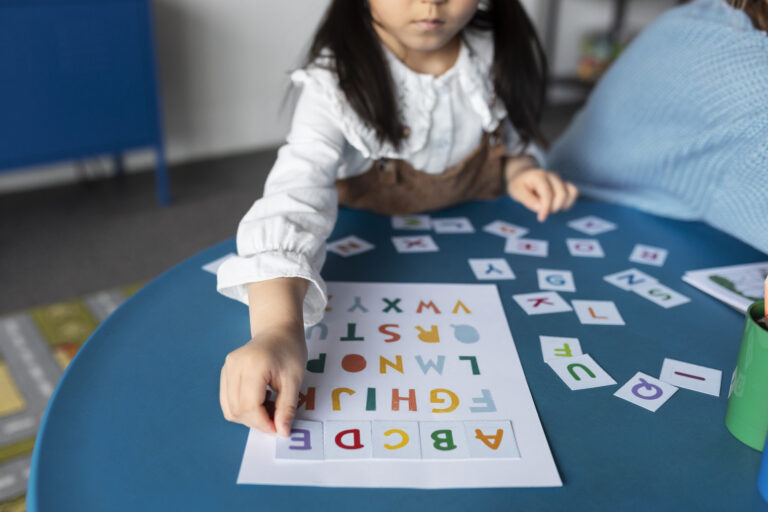
Sandpaper Letters are a set of wooden tiles, each featuring a single letter of the alphabet cut out of fine sandpaper and mounted onto a smooth wooden or board background. The consonants are traditionally mounted on blue (or pink) boards and the vowels on red (or pink) boards — a colour distinction that will later help children understand the difference between vowel and consonant sounds.
The letters are always presented in their cursive or print form — depending on the school’s approach — and they represent sounds, not letter names. This is a crucial distinction that sets Montessori literacy apart from traditional phonics instruction.
Important note: In Montessori, we teach the sound of the letter first — not its name. The letter ‘s’ is introduced as the sound ‘sss’, not as ‘ess’. This makes the leap to blending sounds into words far more intuitive for the child.
The Science Behind the Sandpaper Letters
Why sandpaper? Why not simply show a child a printed letter on a flashcard or a screen? The answer lies in how the young brain learns — and in particular, how multi-sensory experiences create stronger, more durable memory traces than single-sense experiences.
The Three-Pathway Approach
Sandpaper Letters engage three distinct learning pathways simultaneously:
- Visual — the child sees the shape of the letterAuditory —
- the child hears the sound of the letter from the teacher or
- parentTactile-Kinesthetic — the child traces the letter with their fingers, feeling its shape and direction
When all three pathways fire at the same time, the brain forms a much richer, more deeply encoded memory of the letter. Neuroscientists call this multi-modal encoding — and research consistently shows it produces superior retention compared to single-modal learning.
A child who has traced the letter ‘s’ with their fingers thirty times does not need to think about how to write it. The motor memory is already in the hand. The body knows.
Muscle Memory and the Writing Hand
Every time a child traces a Sandpaper Letter, they are rehearsing the exact motor pattern required to write that letter. The direction, the pressure, the flow — all of it is being deposited into muscle memory long before a pencil is ever introduced.
This is why Montessori children often begin writing before they begin reading — a sequence that surprises many parents but makes complete neurological sense. The hand has been preparing quietly all along.
Phonemic Awareness Through Sound

Alongside the physical tracing, the child hears and repeats the phonetic sound of the letter. This builds phonemic awareness — the ability to hear, identify, and manipulate individual sounds in language — which decades of reading research identifies as the single strongest predictor of early reading success.
By connecting sound, sight, and touch simultaneously, the Sandpaper Letters lay a triple foundation for literacy that is both scientifically sound and developmentally appropriate.
When to Introduce Sandpaper Letters
Most children are ready to begin working with Sandpaper Letters between the ages of three and four, though as with all Montessori materials, the child’s readiness is the true guide — not their age.
Signs that your child may be ready include:
- Showing interest in books, stories, and print in the environment
- Asking questions about letters or words they see around them
- Able to sit quietly and focus on a task for several minutes
- Has developed a good three-finger (pincer) grip through practical life and sensorial work
- Showing interest in drawing, mark-making, or writing-like activities
It is perfectly normal for some children to show readiness at two and a half, and others not until four or five. Both are entirely healthy. Montessori is not a race — it is a journey taken at each child’s own pace.
How to Present Sandpaper Letters: The Three-Period Lesson
The Sandpaper Letters are introduced using Dr. Montessori’s Three-Period Lesson — a beautifully simple teaching sequence that moves from introduction to recognition to recall.
Introduce only two or three letters at a time, beginning with sounds that are phonetically distinct and appear frequently in simple words — such as ‘s’, ‘m’, and ‘a’.
Step 1: The First Period — Introduction
Hold up the Sandpaper Letter and say the sound clearly and naturally: ‘This is sss.’ Trace the letter with two fingers (index and middle) in the direction of writing, and invite the child to do the same while you repeat the sound together.
Step 2: The Second Period — Recognition
Lay out two or three letters the child has been introduced to and ask: ‘Can you show me sss?’ The child points to or picks up the correct letter. Vary the activity — ‘Can you put sss on your head? Can you trace sss on the floor?’
Step 3: The Third Period — Recall
Point to a letter and ask: ‘What sound is this?’ If the child recalls correctly, celebrate! If not, simply return to Period One — there is no failure, only more time needed.
Remember: Keep sessions short, light, and joyful. Five to ten minutes is ideal. Never push, test, or drill. The child will tell you when they are done.
From Sandpaper Letters to Reading and Writing
The Sandpaper Letters are not an isolated material — they are the first step in a carefully sequenced literacy journey that the Montessori environment maps out with precision.
The Moveable Alphabet
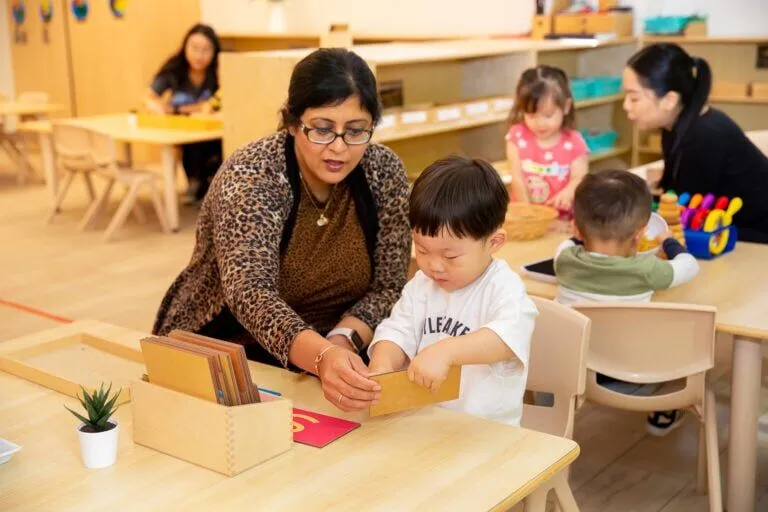
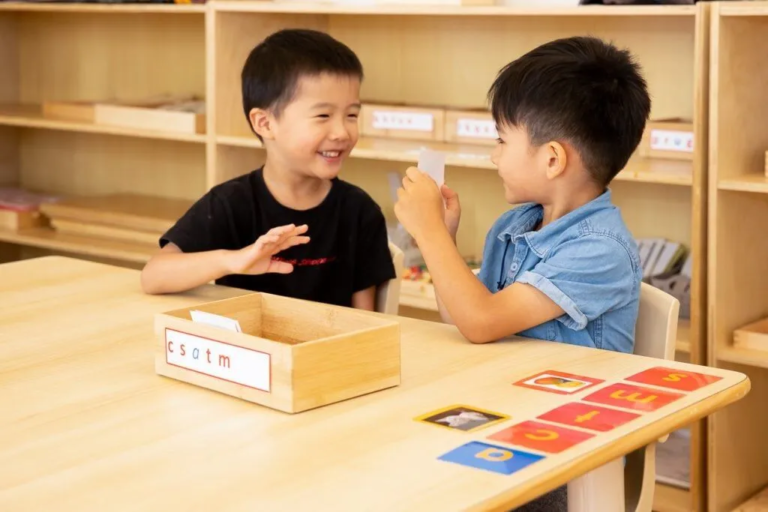
Once a child has internalised several sounds through the Sandpaper Letters, they move on to the Moveable Alphabet — a box of wooden or cardboard letters that the child can physically arrange to build words. This is often the first time a child ‘writes’ a word — spelling it out letter by letter before their hand is yet ready to hold a pencil with control.
Alongside the Sandpaper Letters, the Metal Insets develop the fine motor precision and wrist control needed for writing. Children trace geometric shapes and fill them in with pencil lines — building the exact movements used in cursive and print letters, without the cognitive load of also thinking about sounds and words.
First Writing and Reading
When the hand is ready and the phonetic knowledge is secure, writing and reading emerge — often simultaneously, sometimes even spontaneously. A child who has worked thoroughly with Sandpaper Letters and the Moveable Alphabet frequently sits down one day and begins to write, almost as if they had always known how. In Montessori classrooms, this moment is known as the explosion into writing — and it is one of the most joyful milestones an educator or parent can witness.
Tips for Using Sandpaper Letters at Home
Always trace with two fingers — this replicates the natural writing grip and builds correct motor habits
- Say the sound, not the letter name — ‘aaa’ not ‘ay’; ‘mmm’ not ’em’
- Introduce letters in small groups of 2–3, not all at once
- Begin with sounds from your child’s own name — these are immediately meaningful
- Keep the material on a low shelf where the child can access it independently
- Never correct with frustration — simply model the correct sound and tracing direction gently
- Trust the process — even if your child traces the same letter fifty times, it is never wasted
A Word About Letter Order
In traditional education, the alphabet is taught in order — A, B, C, D. In Montessori, letters are introduced in a sequence based on their phonetic value and frequency in simple words, often beginning with: s, m, a, t, p, i, n — sounds that allow children to start building words quickly once they have learned just a few letters.
This sequence makes the learning feel purposeful and immediately useful. A child who knows ‘s’, ‘a’, and ‘t’ can already build the word ‘sat’ — and there is no greater motivation to learn more letters than the discovery that you can already make words.
Conclusion: A Touch That Opens a World
There is something deeply moving about the Sandpaper Letters. In a world increasingly dominated by screens and digital input, they offer a child something irreplaceable — the experience of learning through the body, through touch, through the unhurried joy of running small fingers across a rough surface and hearing a sound that suddenly means something.
Reading and writing are among the most transformative skills a human being will ever develop. The Sandpaper Letters give children a beginning to that journey that is worthy of its destination — gentle, multi-sensory, joyful, and rooted in a profound respect for how the young mind truly learns.
At KS Montessori, we are passionate about putting the right tools in the hands of every child — and every parent who wants to support their child’s literacy journey at home. Explore our range of authentic Montessori literacy materials and take the first step towards your child’s reading and writing adventure today.
Explore Our Montessori Literacy Materials
One Response