Affiliate Disclosure: As an Amazon Associate, I earn from qualifying purchases at no extra cost to you. I only recommend products that are personally vetted by our AMI-trained team and genuinely align with Montessori principles.
Your 18-month-old is into absolutely everything — dumping, stacking, pulling, throwing, and doing it all over again five minutes later. If you've been searching for the best Montessori toys for 18-month-olds on Amazon, you already know the problem: the platform is flooded with brightly coloured plastic labelled "Montessori" that has nothing to do with the real philosophy.We get it. As AMI-trained Montessori educators, I've seen parents spend good money on toys that their toddler ignores after two days — because the toy does all the work and leaves nothing for the child to discover.
That's why we put together this guide. Every product below has been vetted against AMI Montessori principles: natural materials, single purpose, no batteries, and genuine developmental value for a child at the 18-month stage. Amazon is explored by our team so you don't have to guess.Here are the 7 best Montessori toys for 18-month-olds you can order on Amazon today

What Makes a Toy Truly Montessori at 18 Months?
Before we get into the picks, it’s worth spending a moment on what we’re actually looking for — this will help you make smarter buying decisions beyond this list too.
At 18 months, toddlers are in what Dr. Maria Montessori called sensitive periods — windows of heightened receptivity where the brain is primed to absorb specific skills. At this age, those sensitive periods are centred around:
- Movement — walking, climbing, carrying, and using their hands with increasing precision
- Language — absorbing words at a rapid pace, even if they aren’t speaking many yet
- Order — a strong need for routine, sequence, and things being “just so”
A genuine Montessori toy at this age should honour those windows. Practically, that means
- Made from natural materials — wood, cotton, or wool. These engage the senses differently than plastic and feel more satisfying to handle.
- Single clear purpose — one skill at a time. A shape sorter teaches shape recognition. A stacking ring teaches seriation. Simple is better.
- The child does the work — no batteries, no lights, no music. If the toy entertains without the child’s effort, it’s doing the learning for them.
- Sized for little hands — knobbed pieces, chunky grips, and child-scaled tools all support the development of the tripod grip used later in writing.
- Invites repetition — toddlers learn by doing the same thing 20 times in a row. A good Montessori toy never gets “finished.”
With that in mind, here are our top picks.
Product | Skill Focus | Best Age | Price Range Rating |
|---|---|---|---|
Wooden Shape Sorter | Cognitive Fine Motor | 12-15 month | 15-25$ 5stars |
Knobbed Puzzle 3piece | Fine motor, problem solving | 15–30 mo | 18-30$ 5 stars |
Object Permanence Box | Cognitive development | 10–18 mo | 20-35$ 5 stars |
Practical Life Pouring Set | Concentration, independence | 12–24 mo | 15-28$ 5stars |
The 7 Best Montessori Toys for 18-Month-Olds on Amazon
1. Wooden Shape Sorter — Best for Cognitive Development
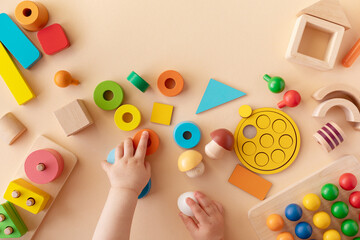
If there is one toy that belongs on every Montessori toddler shelf, it is a well-made wooden shape sorter. At 18 months, your child’s brain is beginning to form categories — round things, square things, things that fit and things that don’t. A shape sorter puts that cognitive process directly in their hands.
The Montessori purpose: Shape sorting teaches discrimination (recognising differences), spatial reasoning (rotating the shape to find the correct angle), and the deeply satisfying concept of “fitting in.” When a toddler finally slots the triangle through the triangle hole after six attempts, the look on their face tells you everything. That moment of self-correction — without any adult telling them “well done” — is pure Montessori.
What we love about it: A good wooden shape sorter has no sounds, no flashing lights, and no cheerful jingle when the piece goes in. The feedback is the piece dropping through the hole. That’s it. That’s enough — and it’s far more powerful developmentally than any electronic version.
What to look for on Amazon: Natural wood with a water-based or non-toxic finish. Avoid versions with more than 6–8 shapes at this age — too many choices overwhelms an 18-month-old and leads to frustration rather than focus. Look for chunky, smooth-edged pieces large enough to avoid any choking risk.
AMI educator tip: Present the shape sorter with only one shape and its matching hole visible at first. Once your child masters that shape, introduce the second. This graduated approach — classic Montessori — keeps the activity challenging but never discouraging.
Price range: $15–25 on Amazon Age range: 12–24 months. For a Box shape sorter: Check Price on Amazon
And for Wooden Knobbed Shape Sorter
2. Wooden Knobbed Puzzle (3-Piece) — Best for Fine Motor Skills
You will find knobbed puzzles in every authentic Montessori classroom in the world, and for good reason. The design — a flat wooden board with shaped cut-outs and chunky knobbed pieces — is one of the most elegant learning tools ever made for a toddler.
The Montessori purpose: The knob itself is everything. When an 18-month-old reaches for the knob with their thumb, index, and middle finger, they are practising the exact same grip they will use to hold a pencil in three years’ time. This is what Montessori called indirect preparation — building a skill long before the child is asked to use it formally.
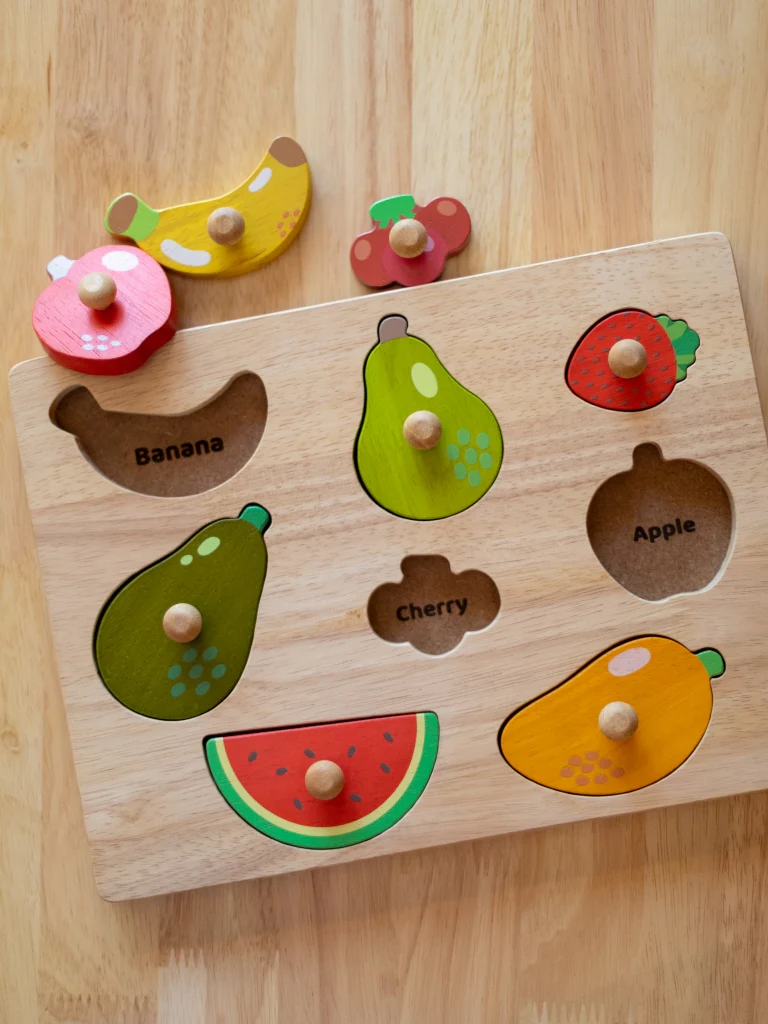
Beyond the grip, the puzzle develops spatial awareness, problem-solving (which shape fits where?), and the satisfaction of completing a task from start to finish independently.
What we love about it: Three pieces is the right number for this age. Fewer than three gives too little challenge. More than five overwhelms. A well-designed 3-piece knobbed puzzle can hold an 18-month-old’s attention for a surprising stretch of time — and every time they complete it, they are building concentration as much as motor skill.
What to look for on Amazon: Smooth, sanded wooden pieces with no rough edges. Knobs that are large enough to grip easily but not so large they become a crutch. Natural wood or simple, muted colours — avoid rainbow-coloured versions that compete for the child’s visual attention and distract from the task.
AMI educator tip: Introduce this puzzle with all three pieces already removed and placed in a line to the right of the board. Sit beside your child — not across from them — and present the puzzle without speaking first. Let them observe, then try. If they struggle, you can guide their hand to the correct space, but resist the urge to do it for them.
Price range: $18–30 on Amazon Age range: 15–30 months
3. Wooden Stacking Rings — Best for Developing a Sense of Order
The stacking ring tower is one of the oldest children’s toys in existence — and there’s a very good reason it has never gone away. At 18 months, this classic becomes a proper Montessori activity when it’s made from natural wood and presented with intention.
The Montessori purpose: Stacking rings introduce seriation — the mathematical concept of arranging objects from largest to smallest (or vice versa). This is the same foundational concept behind the famous Montessori Pink Tower and Brown Stairs. At 18 months, your child won’t stack perfectly in size order yet, and that’s completely fine. The process — picking up a ring, placing it on the post, watching it fall — is the point.

What we love about it: A wooden stacking ring tower offers tremendous repetition value. A toddler can knock it down and rebuild it endlessly. Each repetition refines the wrist rotation and hand placement required to thread the ring onto the post — real, measurable motor development happening through what looks like simple play.
What to look for on Amazon: Natural, unfinished or lightly finished wood. Rings graduated in size with a noticeable difference between each one. A stable base that doesn’t tip easily. Avoid plastic versions — they feel cheap, tip easily, and provide none of the tactile feedback of wood.
AMI educator tip: At first, simply present the rings already stacked and allow your toddler to pull them off one by one. This is enough activity at the very beginning. Once they’ve mastered removal, demonstrate stacking slowly and deliberately — one ring at a time — without narrating what you’re doing.
Price range: $12–22 on Amazon Age range: 12–24 months.
4. Object Permanence Box — Best First Montessori Material
If your 18-month-old hasn’t had an Object Permanence Box yet, now is still a great time to introduce one. This is one of the foundational Montessori infant materials, and its developmental purpose is genuinely remarkable in its simplicity.
The Montessori purpose: Object permanence — understanding that things continue to exist even when you cannot see them — is a critical cognitive milestone. The Object Permanence Box teaches this directly: the child drops a ball into the hole at the top, it disappears, and then reappears from the drawer at the side. The child learns, through repeated experience, that the ball didn’t vanish — it went somewhere.
Beyond the cognitive benefit, this activity also builds hand-eye coordination (aiming the ball at the hole), wrist control, and a satisfying sense of cause and effect.
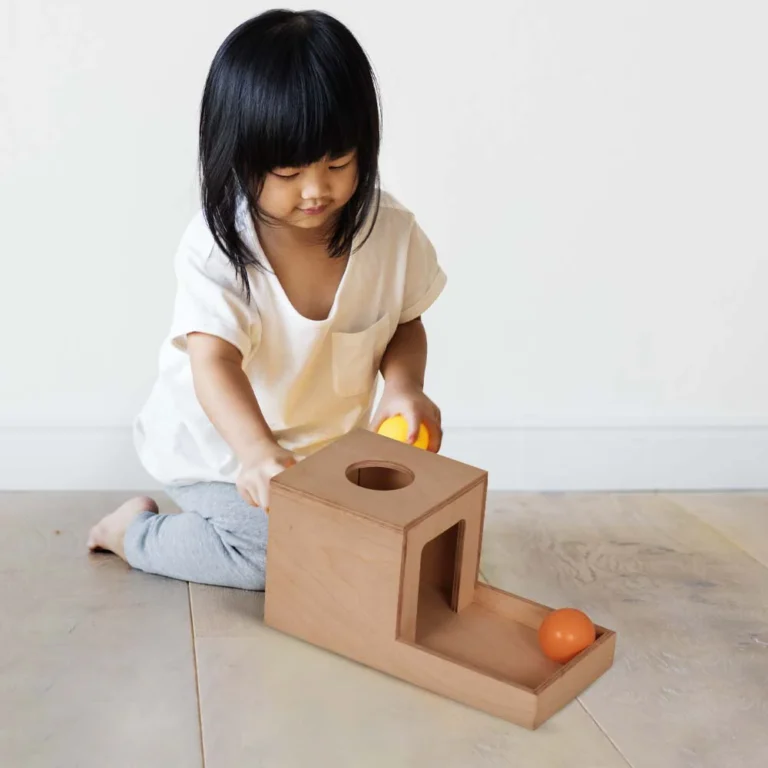
What we love about it: This is one of the purest examples of a Montessori toy — beautifully simple, completely child-directed, and endlessly repeatable. A toddler can work with this independently for a sustained period, which builds the concentration muscle that will serve them for life.
A note on timing: Some 18-month-olds will find this activity a little too easy if they’ve had it since infancy. Watch your child — if they complete it with no engagement, they may be ready for the next challenge. If they haven’t had one yet, it’s still well within the appropriate window.
What to look for on Amazon: A solid wooden box with a smooth drawer mechanism. The ball should be large enough to be completely safe — no choking risk. Natural wood finish, no paint on the ball.
Price range: $20–35 on Amazon Age range: 10–20 months
5. Wooden Push & Pull Toy — Best for Gross Motor Development
At 18 months, many toddlers are newly walking or have been walking for just a few months. Walking is still an act of concentration and balance — it hasn’t yet become automatic. A wooden push or pull toy makes walking purposeful, and purpose is at the heart of Montessori.
The Montessori purpose: In Montessori, movement is never separated from learning. The sensitive period for movement at this age means your toddler needs to move — and channelling that movement into purposeful activity is far better than simply letting them roam. A push toy gives the walk a destination and a reason. A pull toy introduces the concept of caring for something, leading something, being responsible for movement.
Both types also strengthen the core, improve balance, and develop spatial awareness — understanding where your body is in relation to objects around you.
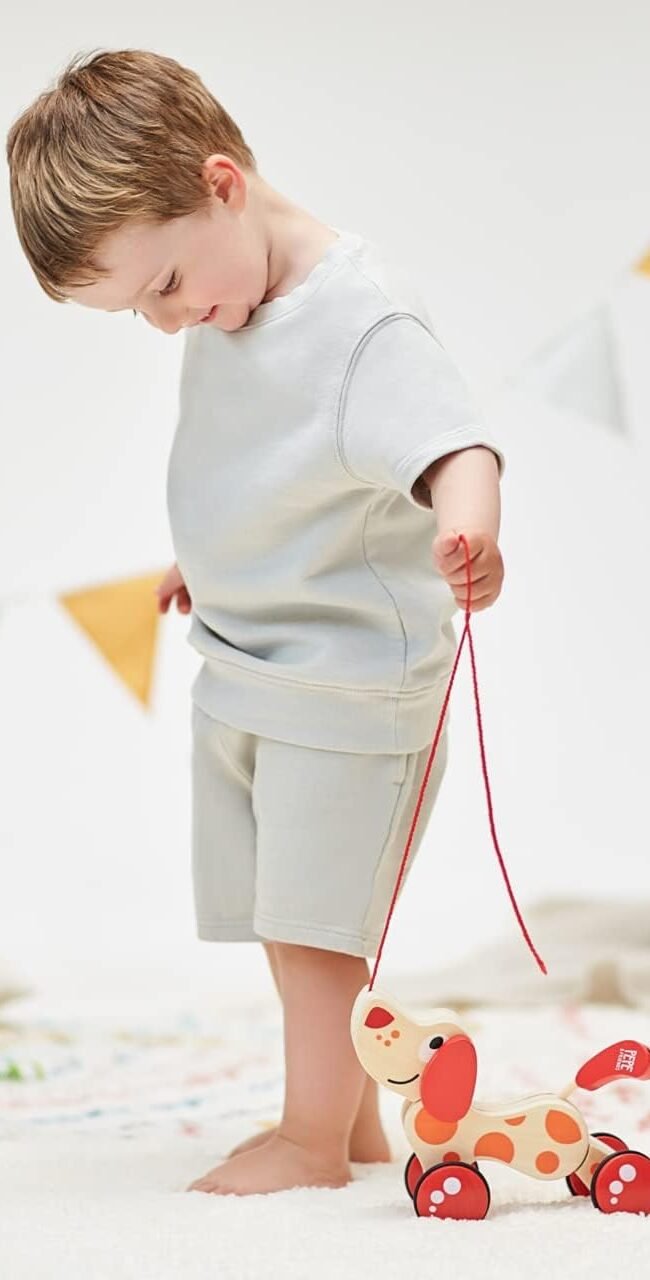
What we love about it: Unlike walkers (which Montessori discourages because they inhibit natural balance development), a push toy moves only when the child moves. The child is in charge. The toy is the follower. That distinction matters enormously in Montessori philosophy.
What to look for on Amazon: A handle at the correct height — roughly the child’s waist level when standing. Smooth, quiet wheels that don’t move too fast. Solid wood construction that can take the inevitable crashes. Avoid toys that play music or make electronic sounds when pushed.
AMI educator tip: Let your toddler push the toy wherever they want — don’t direct the walking activity. The point is autonomous movement, not a prescribed path.
Price range: $25–45 on Amazon Age range: 12–24 months
6. Practical Life Pouring Set — Best for Building Independence
Of all the activities in a Montessori home or classroom, Practical Life is the most important — and the most underestimated by parents who are new to the method. Pouring is one of the earliest and most powerful Practical Life activities you can introduce, and 18 months is the perfect age to start.
The Montessori purpose: Pouring dry materials (rice, lentils, small pasta) from one small pitcher to another develops fine motor control, concentration, hand-eye coordination, and — most importantly — a sense of competence and independence. When an 18-month-old successfully pours from one vessel to another without spilling, they experience genuine achievement. That feeling of “I did it myself” is the engine of Montessori education.
This directly prepares the child for pouring water (introduced a little later), which then leads to helping set the table, preparing snacks, and eventually participating meaningfully in the life of the home.
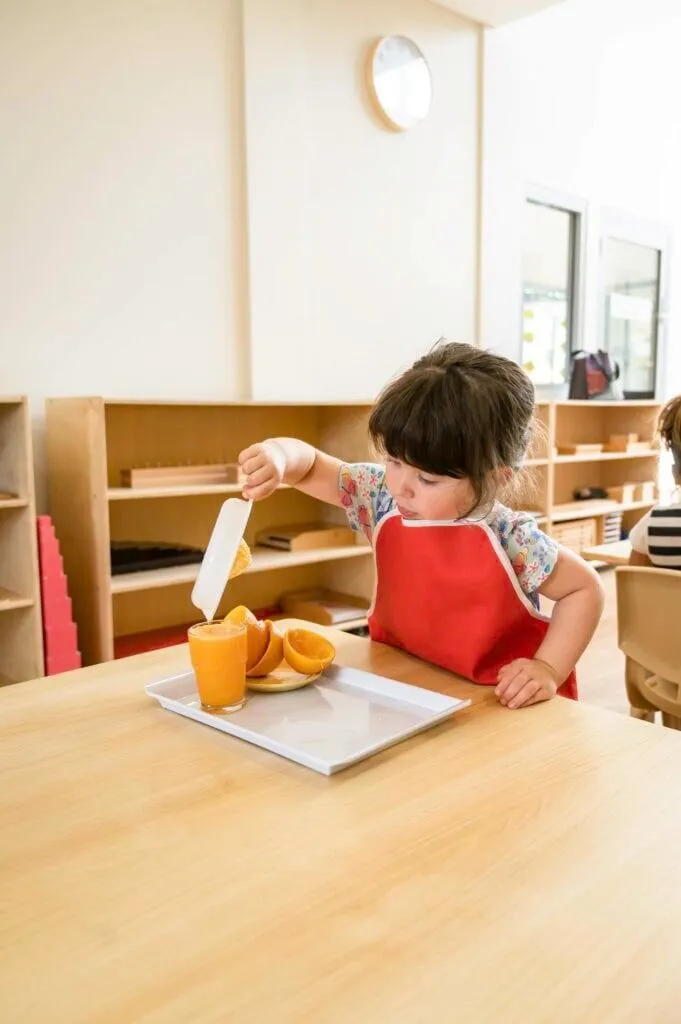
What we love about it: There is no “end goal” to distract from the process. The child pours from left to right, then back again, over and over. The repetition is the learning. A small tray underneath catches spills and defines the workspace — teaching tidiness without any lecture.
What to look for on Amazon: Small ceramic or wooden pitchers with a proper spout — not plastic cups. The weight and feel of real materials matters. A simple wooden tray to define the workspace. Look for child-sized pitchers, not regular kitchen ones.
AMI educator tip: Always start with dry materials before water. Set the tray up at a low table or on a mat on the floor. Present the pouring movement slowly, without speaking — pour from the left pitcher into the right, then invite your child to try. When they finish, show them how to place both pitchers back to the left. Let them manage any spillage with a small cloth kept nearby.
Price range: $15–28 on Amazon Age range: 18–36 months
7. Wooden Pounding Bench — Best for Cause & Effect
Every parent of an 18-month-old knows the urge to bang, hit, and pound is completely overwhelming at this age. Rather than fighting it, a wooden pounding bench channels it into something purposeful — and that, in a nutshell, is the Montessori approach to toddler behaviour.
The Montessori purpose: The pounding bench teaches cause and effect (I hit this peg, it moves down), gross motor control (aiming the mallet), and simple spatial reasoning (the peg is going somewhere). When the child has pounded all the pegs through, they flip the board and discover they can start all over again — an elegant, self-resetting activity that keeps engagement going.
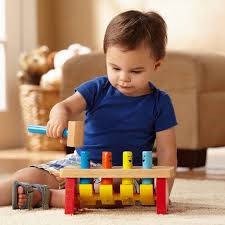
What we love about it: There is something deeply satisfying about the thud of a wooden mallet on a wooden peg that plastic simply cannot replicate. The sound, the weight, the resistance — all of it provides rich sensory feedback. And because the activity resets itself, a child can work with this independently for a long stretch.
What to look for on Amazon: Solid hardwood construction — soft wood dents quickly under enthusiastic toddler use. A mallet that is the right weight for small hands (not too heavy). Smooth, rounded pegs. Avoid any version with painted decorations on the pegs, as the paint chips quickly with hard use.
Price range: $18–30 on Amazon Age range: 12–24 months
Buying Guide: How to Choose Montessori Toys on Amazon
Amazon is an incredible resource for Montessori families, but it requires a careful eye. Here’s what our AMI-trained team checks before recommending any product.
Look for natural wood and non-toxic finishes
Real Montessori materials are made from natural wood — it’s tactile, beautiful, and durable in a way plastic isn’t. On Amazon, look specifically for listings that mention “non-toxic,” “water-based paint,” or “FSC-certified wood.” If the material isn’t mentioned in the product description, check the Q&A section or reach out to the seller directly. At KS Montessori, we only recommend materials that clearly state their finish is safe for children.
Avoid battery-operated and electronic toys
This is the single most important filter. If a toy has batteries, lights, or plays music on its own, it is not a Montessori toy — regardless of what the listing says. Montessori philosophy holds that the child must be the one doing the work. A toy that entertains without the child’s active engagement is doing the learning for them, not with them. When you search Amazon, adding “-electronic” or “-battery” to your search terms can help filter these out.
Choose toys with a single clear purpose
At 18 months, the brain learns best when it can focus on one thing at a time. A toy that sorts shapes AND plays music AND has flashing lights AND makes animal sounds is overwhelming, not enriching. The best Montessori toys do one thing — and let the child do it beautifully and repeatedly. Simple is not boring. Simple is respectful of how toddlers actually learn.
Match the toy to little hands
Check product dimensions before buying. At 18 months, hands are small and the pincer grip (thumb and forefinger) is still developing. Knobbed puzzle pieces should have a knob large enough to grasp easily but not so large it removes the challenge. Puzzle pieces should be chunky. Pitchers should be small enough for a toddler to hold with both hands. When in doubt, look for products specifically labelled for the 12–24 month age range.
Rotate toys — less is always more
One of the most powerful — and most counter-intuitive — things you can do is put most of your toddler’s toys away. Montessori recommends presenting just 3–5 activities on a low shelf at any one time, rotating them every week or two. This keeps each toy fresh and interesting, builds deeper concentration, and prevents the overwhelm that comes from too much choice. You don’t need to buy more toys. You need to be more intentional with the ones you have.
Frequently Asked Questions
1.What Montessori toys are best for an 18-month-old/Toddlers?
The best Montessori toys for 18-month-olds focus on practical life, fine motor development, and sensory exploration. Our top picks are the wooden shape sorter, Knobbed puzzle, Sensory material and Practical life pouring set — all available on Amazon and all genuinely aligned with AMI Montessori principles. Start with one or two and observe which activities your child returns to most often.
At Kiran Saif Montessori Materials, we recommend carefully selected Montessori-inspired toys that support concentration, coordination, creativity, and early childhood development in a natural and engaging way.
2.Are the "Montessori" toys on Amazon actually Montessori?
Honestly, many are not. The word "Montessori" is not trademarked, so any seller can use it. The key is to evaluate the toy itself rather than its label: Is it made from natural wood? Does it have a single clear purpose? Does it require the child to do the work? Does it have no batteries or electronic components? If yes to all four, it's likely genuinely Montessori in spirit. Every product on this list has been checked against these criteria by our AMI-trained team.
3. Is 18 months too young for Montessori materials?
Not at all — in fact, 18 months is one of the richest ages to begin introducing purposeful Montessori activities. Toddlers at this stage are in sensitive periods for movement, language, and order, making them naturally drawn to activities that give them real skills and real autonomy. Many children have been introduced to Montessori materials from birth.
4. How many toys should my 18-month-old have on their shelf?
Three to five activities at a time is the Montessori recommendation. More than that tends to overwhelm rather than enrich. Rotate your toy selection every one to two weeks — bring out what was stored and put away what's been out. This simple practice can dramatically increase how engaged your toddler is with each activity. You can also check a guide for this purpose. Montessori Essential Guide.
5. Do I need to buy expensive Montessori materials?
No. Some of the most valuable Practical Life activities cost nothing — pouring water, sweeping with a child-sized brush, wiping a table. The toys on this list are all under $45, and you don't need all seven. Start with one or two that match what your child is currently drawn to, and build from there. Our free Montessori Home Starter Checklist can help you prioritise.
6. Where can I buy high-quality Montessori toys for 2–5 year olds?
Parents looking for high-quality Montessori toys for children aged 2–5 should choose materials that encourage independence, hands-on learning, concentration, and fine motor development. At Kiran Saif Montessori Materials, we carefully curate Montessori-inspired materials, wooden learning toys, practical life tools, sensorial activities, and educational resources designed to support early childhood development in a meaningful and engaging way. Our recommendations focus on age-appropriate, child-safe, and skill-building materials that align with Montessori learning principles for toddlers and preschoolers.
Final Thoughts
At 18 months, your child doesn’t need a playroom full of toys. They need a handful of beautifully simple, purposeful materials that let them work, repeat, and discover on their own terms.
The seven toys on this list have been chosen because they honour exactly that. Each one gives your toddler something real to do — a problem to solve, a skill to build, a sense of competence to earn. That’s Montessori. And it doesn’t have to be complicated or expensive.
If you can only start with one, make it the Wooden Shape Sorter. It covers cognitive development, fine motor skills, and keeps toddlers meaningfully engaged for months. From there, add the Knobbed Puzzle and a Practical Life Pouring Set, and you have the foundation of a genuinely Montessori home environment at 18 months.
Want to know exactly what your toddler needs at every age?
Download our free Montessori Home Starter Checklist — a room-by-room guide to the AMI-aligned materials that are worth buying (and the ones you can safely skip).